

Final Empire: Revival of Rome?
(Published December, 2024; this Post appears also as one of the Capsule Summaries; Scripture quotations are from the NKJV Bible, unless noted otherwise)
Many a commentary has explained the world’s final empire before the Return of Christ in terms of a revival of the ancient Roman empire. This idea is based, logically enough, on the prophetic passage in the Book of Daniel, chapter 7.
After this I saw in the night visions, and behold, a fourth beast, dreadful and terrible, exceedingly strong. It had huge iron teeth; it was devouring, breaking in pieces, and trampling the residue with its feet. It was different from all the beasts that were before it, and it had ten horns. (7:7)
Chapter 7 goes on to explain that this “fourth beast” (empire), gets destroyed by the Son of Man (Jesus Christ) at the End of the Age, at which time He takes over the rulership of the world. (7:9-14) Now, in the progression of “beasts” that Daniel saw in vision, it is clear that this “fourth beast” should be identified with ancient Rome.
But the picture in chapter 7 also portrays the “fourth beast” as being around in the End Time when Christ returns in power and glory (and destroys the Beast). So, it is quite reasonable to assume that in some way the ancient Roman empire is to re-emerge as the final empire to rule over Israel, the Mideast, and most of the rest of the world in these last days before the Return of Christ.
But the question of how exactly to make that connection between the ancient and modern empires has puzzled Bible teachers and scholars for generations.
Many commentaries fixate on trying to project how the ten-horns feature of this “fourth beast” might show up as the continuation of the Roman empire. In the early days, commentaries tried to envision the various barbarian tribes who invaded Rome as the 10 horns. In recent times it was thought that the nations of Europe could fit this role. There was even a time in the 1980’s when there were 10 nations in the European Union. But now that number has climbed to 27 nations.
So, is there another better angle from which to view this mystery about the “fourth beast”? Well, if we look closely at chapter 2, that might help. In that chapter (the companion to chapter 7), Daniel and Nebuchadnezzar both had the vision of a great “image” that represented all the same empires that appear in chapter 7.
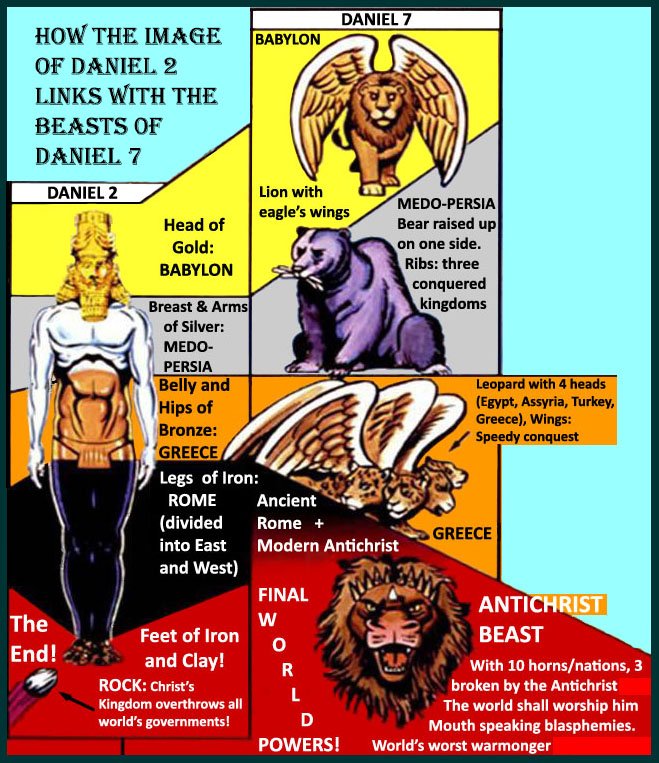
Illustration adapted from publication of The Family International
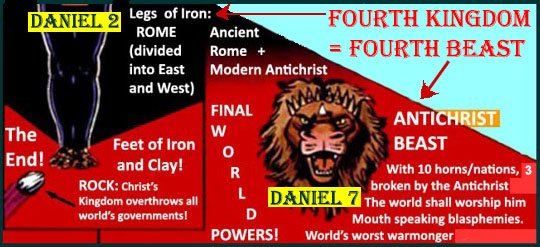
What was known as the “fourth beast” in chapter 7, is called the “fourth kingdom” in chapter 2. This “fourth kingdom” straddles both legs and feet of the image, which corresponds to how the “fourth beast” from chapter 7 symbolizes both ancient and modern empires. (2:40; 7:7,23)
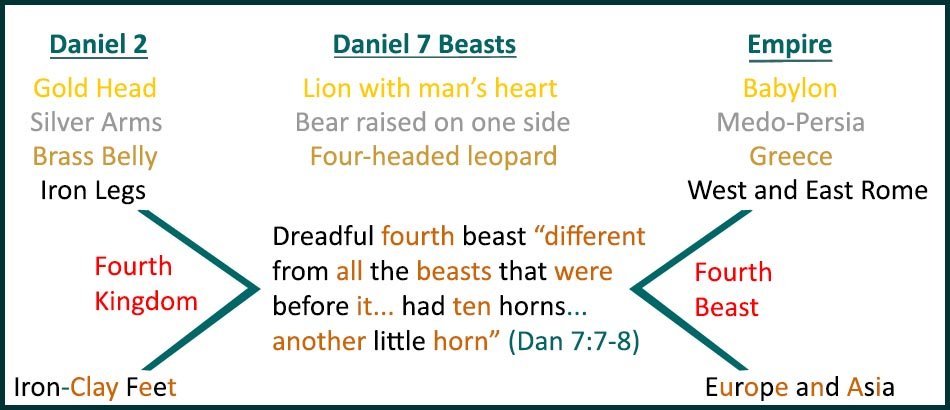
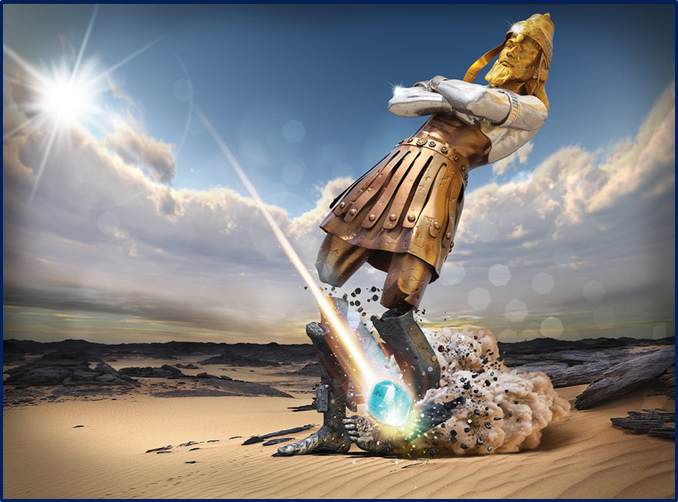
The legs of iron represent the dual empire of West and East Rome, and the feet represent the final empire to come before the Return of Christ. We know the feet come at the End of the Age because the Stone (who represents Christ) strikes the feet of the image, destroying the whole thing and resulting in establishment of God’s Kingdom. “The stone that struck the image became a great mountain and filled the whole earth.” (2:35)
Note that chapter 7 envisions both ancient and final empires as represented in one single Beast, whereas the parallel revelation in chapter 2 represents the same as two body parts (legs and feet).
Why one Beast for two eras and two empires? Perhaps because the Coming of the Son of Man (Jesus Christ) happens in both time periods. His First Coming happened during the time of the ancient Roman empire, and His Second Coming will happen during the time of Earth’s final empire under the Antichrist. For this reason, the ancient and modern eras and empires, ancient and modern, are seen in the eyes of God as one “fourth beast”. The Coming of the Son of Man into our Earthly Realm is like one continual event, taking place in two stages we might say.
There is a saying about the nature of time – that time is God’s way of keeping things from happening all at once.
Here in chapter 2, there is another common feature that appears in both the “ancient” legs of Rome and the “modern” feet of the final empire: the “iron” metal that runs through both legs and feet. The other metals in the “image” point to the authoritarian nature of those empires, all of whom conquered Israel and the Mideast world with their powerful armies. And the same is true of the Roman empire of the legs, of whom it is said,
And the fourth kingdom shall be as strong as iron, inasmuch as iron breaks in pieces and shatters everything; and like iron that crushes, that kingdom will break in pieces and crush all the others. (2:40)
That “iron” strength was certainly true of ancient Rome, and that aspect of the ancient empire continues into the final “feet” version of the “fourth kingdom”. For the passage goes on to say about the “feet”, that even though “the kingdom shall be divided; yet the strength of the iron shall be in it.” (2:41)
Now this “iron” component points to intangible features – the “strength” of military rule, efficient republican government and legal system – that characterized ancient Rome. And that will also characterize the rule of the final empire.
But this kind of republican government exists to some degree or other in most countries of the modern world. The “iron” feature does not represent the actual physical, geographical nature of the “fourth beast”.
So, is there any other connection between ancient and modern empires – something that would clearly pinpoint the actual territories involved?
To find that connection, we can look at the parallel revelation in Daniel chapter 2 of the “image”. The peculiar feature that relates to our question lies in how the body parts of the “image” reflect the geographical and chronological nature of the empires that ruled over Israel:
- The single head of gold – empire of Babylon
- Next, the two silver arms and breast – the dual empire of Media and Persia
- Next, the belly of brass – the empire of Alexander the Great (note that the Medo-Persian and Greek empires had almost the same boundaries, which seems to reflect the similar boundaries between the chest and belly of the “image”)
- Next, the two legs of iron – the dual empire of West and East Rome.
- Next, the two feet – representing… ?
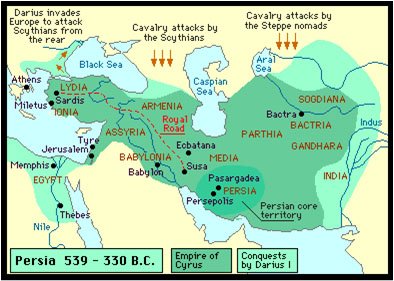
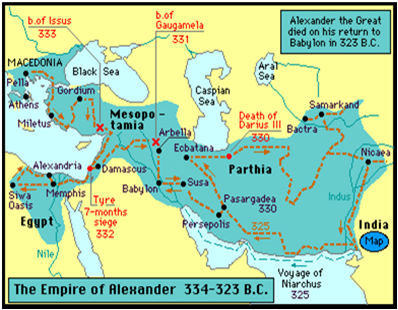
Empires of Medo-Persia and Greece have almost the same boundaries
So then we are left with the feet of the image. One obvious conclusion: the final empire would have to be a dual territory. A less obvious conclusion: the geography would differ from that of ancient Rome (a foot is not the same as a leg); yet the final empire should connect to the ancient empire in some way (feet connect to legs).
The big question now is, can we see something like this taking shape in the modern world? The ancient Roman empire was divided into West and East, roughly between European and Asian territories, and between two different cultures. (Tribal territories of the West were assimilated and adopted the Latin language and Roman Catholicism; eastern territories, once major civilizations, kept their traditional customs and language but adopted Orthodox Christianity.)
In our modern day we have the benefit of some historical hindsight that was not available in times past. In very recent history, we are witnessing the rise of a new and very powerful empire. China’s Belt and Road Initiative (BRI) infrastructure projects are uniting the Eurasian landmass. The powerful nations of Russia and China have become strong allies. In fact, Russia, according to the prophetic passages in the Book of Ezekiel, chapters 38-39, will invade the Middle East in the “latter days” to become the final power to rule over the Israeli nation. (For more information, see the series of posts, Ezekiel 38-39.) So Eurasia looks destined to become the next ruling empire, the final one headed by the Antichrist. This we can foresee will happen once the collapse of the American empire has come to pass. (Learn about this in the Book of Revelation from the series of posts, Fall of the Great Harlot.)
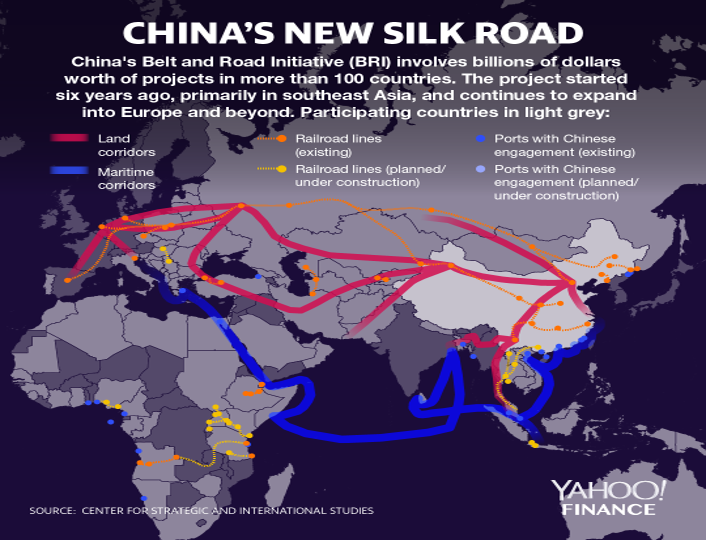
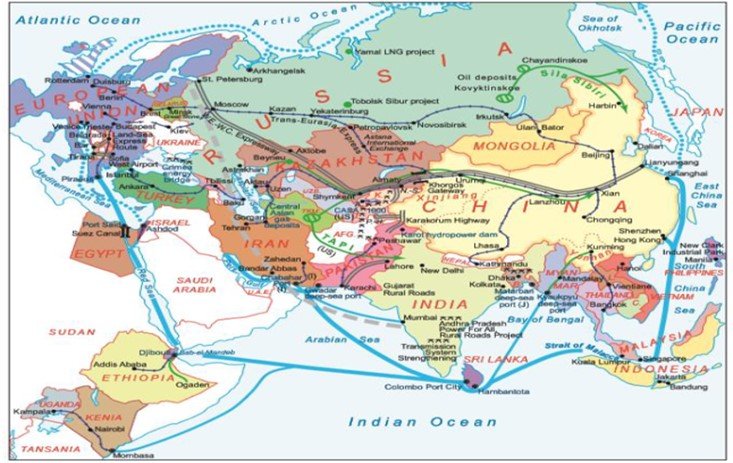
And how has this huge landmass of Eurasia been divided? The Ural Mountain range divides European Russia (and Europe) from Asian Siberia and many other nations to the east (including China). The Caucasus Mountains divide European Russia from Asian nations to the south, the Middle Eastern nations. Remarkably, it is similar to the East-West, Europe-Asia division of ancient Rome. There is even a cultural division – mostly between the Christianized cultures of the West and the non-Christian cultures of the East (Islamic, Buddhist, Hindu, Confucian, Communist).
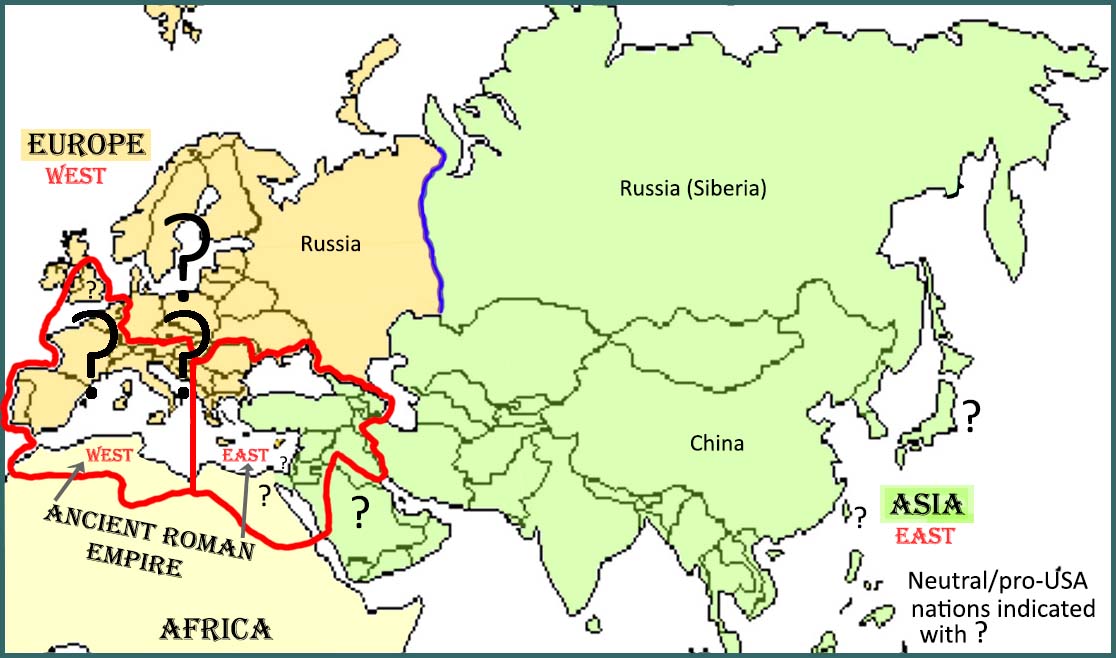
[By the way, whether a nation has a “Christian” or “non-Christian” culture is not meant to be a value judgment. In the eyes of the Almighty, and on the geo-political level, what matters is how much a nation seeks for peace and stability in the world. Sad to say, in today’s world those nations who have Christian culture are misbehaving on this level. They should be the peacemakers, but instead, seem to have become the warmongers of modern times.]
So this seems to answer the puzzling question of how the “fourth beast” in Daniel chapter 7 emerges as a revival of ancient Rome. The key in all this is to link the information about the “fourth beast” in chapter 7 and factor it in with the information given about the “fourth kingdom” in chapter 2.
So what about the “ten horns”? Since our conception of the “fourth beast” has undergone some expansion and includes a lot more than just ancient Rome, that throws a whole new light onto that question. Since the modern empire links to ancient Rome, simply by virtue of it being the expanded version of the ancient West-East, Europe-Asia divide, there is no need anymore to find some way to link those Ten Horns to the ancient Roman empire. And in the huge landmass of Eurasia, there are many countries other than those in Europe or the Mideast to choose from.
And we could add this small detail: the toes of the Daniel 2 “image”, which are usually considered equivalent to the Ten Horns of the “fourth beast”, do not come out of the legs of the image, but out of its feet; that is, they belong to the expanded End Time portion of the ancient Roman empire, the power bloc that is growing now by leaps and bounds in the great landmass of Eurasia.
A good possibility for the identity of the Ten Horns is the Commonwealth of Independent States. This association consists of Russia plus ten smaller territories that border Russia to the west and to the south. They form a sort of buffer zone – like horns that can protect Russia along its very long borderland territory. There are many details to cover on this subject, and a thorough study of it can be found in the post, “Ten Horns Coming into View?”
So, isn’t it remarkable how the End Time scenario is unfolding before our eyes? And how historical events are lining up so accurately with what the prophetic passages in the Books of Daniel and Revelation foretold so long ago. It is reassuring to know that God has planned it out well ahead of time. Despite all the confusion and chaos, there is a predetermined end to it, followed by the glorious Age of Peace, the Millennium (also foretold, in the Book of Revelation, chapter 20).
