

1. Retrieving Our Lost Heritage
2. A Previous “End of the Age”?
3. Dual Nature of the Final Empire: Two Power Sources, Two Religious Strongholds, Two Territories
9. Ten Horns Coming into View?
10. Gabriel’s Prophetic Proclamations: Ancient Past or Near Future?
12. Hell in Heaven? Heaven in Hell?
14. The Final Empire: Revival of Rome?
15. Skeleton Outline of Ezekiel 38-39
16. Skeleton Outline of Daniel 2 and 7
17. Skeleton Outline of Daniel 8
18. Skeleton Outline of Daniel 9
19. Skeleton Outline of Daniel 10-12
SKELETON OUTLINE OF EZEKIEL 38-39
(Based on the series of Posts Ezekiel 38-39: Ancient Prophet Glimpses Modern World! )
Clues to the Modern Setting of Ezekiel 38-39:
RUSSIA?
- Magog, Rosh, Meshech, Tubal – ancient names for tribes and places in Russia. (38:2,3, 39:1)
- From the “far north” (38:6,15, 39:2)
MODERN TIMES?
Modern era:
- “Latter years” – 38:8
- “Latter days” – 38:16
Modern Israel: The Jews had returned from exile in previous history, but only from Babylon, one nation. Here they are shown to have returned (after a long time) from many nations, which has happened only in recent history.
- “You will invade a land that has recovered from war, whose people were gathered from many nations to the mountains of Israel, which had long been desolate… brought out from the nations, and now all of them live in safety.” (38:8, NIV)
- “A people gathered from the nations” (38:12)
- “I have brought them back from the peoples, and gathered them out of their enemies’ lands, and… brought them back to their land” (39:27-28)
Modern conditions:
- “The land of unwalled villages… without walls, and having neither bars nor gates.” (38:11)
- “Persia, Ethiopia, and Libya… Gomer… Togarmah” (38:5, 6).
In ancient times these nations had no relation with Israel (except Persia who permitted the captive Jewish people to return to their own land in ancient times). Only in modern times have they become anti-Israel; only now can we see the possibility that these nations (now called Iran, North Sudan, Libya, and Turkey/Armenia) could in the near future join with Russia to fight in a war against Israel.
“Gomer” is also mentioned. It is hard to know right now how exactly “Gomer” fits into the picture. However, since the modern name Crimea is derived from “Gomer”, this could very well identify it as the province of Crimea, which Russia annexed from Ukraine in March, 2014. Because of its location, this region has strategic military value and could easily play an important role in Gog’s future wars against Israel.
- “Sheba, Dedan, the merchants of Tarshish, and all their young lions will say to you, ‘Have you come to take plunder?’” (38:13) – Sheba and Dedan are ancient names for Saudi Arabia and Kuwait. Merchants of Tarshish refers to the ancient mini-empire (within the Phoenecian commercial empire) that carried on its trading activities with western Europe and England. Merchants of Tarshish was an indirect reference to the future Colonial empires of Europe (with “all their young lions” or colonies – especially America, and former European colonies now under American control). They and the wealthy oil states of the Middle East will be concerned about the rising power of the Russian Federation, wondering if it intends to take away their wealth.
*
Connection to the Book of Revelation
- 38:19-23 Earthquakes, pestilence bloodshed, hailstones, fire, and brimstone these are all features of the final Plagues of the Wrath of God in Revelation 16
- 39:4 and 39:17-20 birds and animals gather to feed on the carcasses of the dead; also in Revelation 19:17-18
*
Ezekiel 38-39 about the Antichrist?
- Gog: a title of disrespect that Jewish people gave to their worst enemies. Since Gog is pictured in Ezekiel 38-39 as the one who invades the land of Israel in the End of the Age era, he therefore qualifies as an enemy of the Jewish people. Of course, what is often overlooked is the fact that God allows him to afflict the Jewish people – for the same reasons that he allowed Assyria, Babylon, the Seleucid empire, and Rome to conquer Israel in ancient times.
[RETURN TO INDEX]
*
SKELETON OUTLINE OF DANIEL 2 AND 7
(This outline is from the series of Posts Daniel 2: Shape of the Future and Daniel 7: Amazing Dream! )
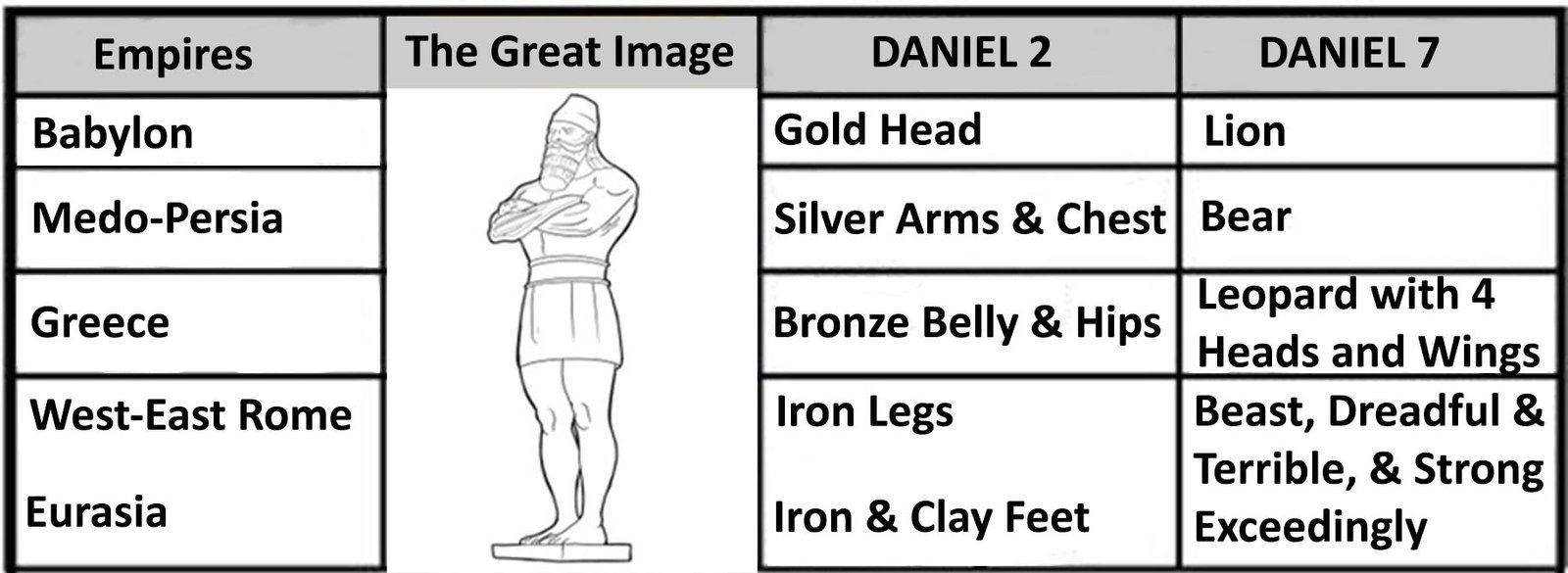
Fifty years have passed since Daniel and Nebuchadnezzar had their astounding dream about the “image”, recounted in Daniel chapter 2. And now, it is time again for Daniel to receive more revelations about the future. In chapter 7 the Lord seems to start things off with a repeat of the revelation Daniel had received as a youth. Only this time he sees the same empires from a different perspective – how the empires of man appear in the eyes of God.
DANIEL 2 SYMBOLISMS
- Metals: Conquest by military
- Clay: Conquest by wealth/industry
- Body Parts: reflect geographical/chronological nature of empires
- Materials: reflect spiritual nature of empires
- Iron/Clay: Militarism mixes with Materialism → powerful religion: Emperor-worship + worship of Materialism
- Legs of iron: West/East territorial division of ancient Rome (European and Asian nations)
- Legs connect to Feet
- Feet continue West/East territorial division of Rome into the west/east division of Eurasia (European and Asian nations)
HOW DANIEL 7 CORRESPONDS TO DANIEL 2
- Beasts of Daniel 7 match with body parts of Image in Daniel 2
- “Fourth beast” of Daniel 7 matches with “fourth kingdom” of Daniel 2
- “Fourth kingdom” contains Legs and Feet – 2 empires – one ancient, one modern
- “Fourth beast” also should contain 2 empires, ancient and modern
WHAT THE ANCIENT AND MODERN VERSIONS OF “4th BEAST” HAVE IN COMMON:
- God reveals Himself through Jesus Christ
- First Coming during ancient Roman times
- Second Coming during the final empire
- Both rule over nation of Israel
- Jerusalem invaded in both eras
- Organized persecution against believers
- Rome’s republican government, law codes still in effect
NOTE: Embellished details show that 4th Beast is more than just ancient Rome. It is also a MODERN empire
DANIEL 7 SYMBOLISMS:
- Beast symbolism reveals inhuman savagery of empires
- Modern version of the “fourth beast“? Russian Federation (in Ezekiel 38-39)
- Who are the “ten horns“? Commonwealth of Independent States forms buffer zone protecting Russia’s long border
- 3 “plucked up by the roots”: Ukraine, Georgia, ?
- “Ten horns” also symbolized in 10 toes of Daniel 2 Image
- Toes connect to the feet, not the legs
- Toes connect to the MODERN version of the “fourth beast”, not the ANCIENT version
WHAT HAPPENS TO THE “4th BEAST”, AND AFTERWARDS?
- Ancient of Days sits, judges “fourth beast”; bestows kingdoms of Earth to Son of Man (7:9-14)
Spirit being explains dream to Daniel (7:15-27)
- Under the “fourth beast”, there will be persecution
- For “time, times, and half a time” (3½ years)
- “Fourth beast” speaks blasphemies against God
- Saints and Son of Man inherit and rule the Earth
FINAL NOTE: Both chapters end with Christ’s Coming to establish God’s Kingdom on Earth. Pictured as a Stone coming to destroy the Image, then becoming “a great mountain” that “filled the whole earth” (2:35) And in chapter 7, “The kingdom and dominion, and the greatness of the kingdoms under the whole heaven, shall be given to the people, the saints of the Most High. His kingdom is an everlasting kingdom, and all dominions shall serve and obey Him.” (7:27)
*
SKELETON OUTLINE OF DANIEL 8
(Based on the series of Posts Daniel 8: Bridging Past and Future)
THE VISION
- Daniel receives a vision, not a dream this time, of a two-horned ram going west, north, and south. It becomes very powerful until a he-goat with a single great horn came from the west and destroyed the ram
- The he-goat’s great horn then gets broken, and in its place four horns spring up. Out of one of those horns, a “little horn” springs up, conquers towards the south, east, and to Israel. He defies the “Prince of the host” and His people and their religious practices.
- That “little horn” identifies with the one in Daniel 7, who was obviously the Antichrist coming in the End of the Age. However, there is a secondary identification with another Antichrist-like person who came to power only 400 years after Daniel received this revelation. This was Antiochus IV Epiphanes who tried to impose Greek religion on the ancient Israeli nation.
CONVERSATION ABOUT A TIME SPAN OF 2,300 DAYS
- Then Daniel overhears a conversation between two “saints” and learns that this persecution will last 2,300 days. This time span was given to reassure the Jewish people then that their persecution would not last forever. And it so happened, after Antiochus Epiphanes had sacrificed a pig in 167 BC on the Jewish altar (“transgression of desolation” in 8:13), that about 2,300 days later, the Jewish army won a decisive victory over the Syrian forces in the Battle of Adasa in 161 BC. Israel became an independent state after that for about 100 years until the Romans came.
ENTRANCE OF GABRIEL
- At this point when Daniel is wondering what this vision means, the angel Gabriel is sent to explain that the vision is meant for the End of the Age. Daniel apparently had restricted his understanding of the vision to the near-future persecution against Israel with its time span of 2,300 days. This direct encounter with an angel is a bit much for Daniel, and he faints but is re-strengthened and able to continue receiving Gabriel’s words.
GABRIEL EXPLAINS THE VISION
- Gabriel tells Daniel plainly that the ram and the he-goat were symbolic of the upcoming empires of Persia and Greece and that the great horn of the he-goat is the “first king” who can be none other than Alexander the Great.
- Gabriel goes on to describe different features about the “little horn” who, in the vision, causes so much trouble:
1) “In the latter time of their kingdom” – Context is the same Middle East area in a distant future (modern times)
2) “When the transgressors have reached their fullness” – A corrupt world has reached its ultimate, final stage
3) “A king shall arise, having fierce features” – The final king and his empire will be ruthless
4) “Who understands sinister schemes”- Has great wisdom from the realm of Darkness
5) “His power shall be mighty, but not by his own power” – Great power given to him by the Dark spiritual forces of Satan
6) “He shall destroy fearfully” – Modern means of destruction will be used against the Harlot empire (with the permission of God, similar to why Assyria, Babylon, Rome were allowed to destroy ancient Israel)
7) “And shall prosper and thrive” – He will succeed in his conquests over the Earth
8) “He shall destroy the mighty, and also the holy people” – He will destroy powerful people and nations, and communities of true believers will suffer much persecution
9) “Through his cunning he shall cause deceit to prosper under his rule” – With the False Prophet’s help, he will wage a war of deceit – propaganda – to persuade the world to follow him
10) “And he shall exalt himself in his heart” – Such arrogance has led to the downfall of so many of the world’s great conquerors
11) “He shall destroy many in their prosperity” – Many of his enemies’ nations will suffer unexpected destruction, similar to what is described in Revelation 18:7-8 about the Harlot empire
12) “He shall even rise against the Prince of princes” – Ultimate defiance (against God) results in…
13) “He shall be broken without human means” – His defeat, not by an opposing worldly power, but, directly and supernaturally, by the hand of God in the Battle of Armageddon
- At the end of their conversation, Gabriel tells Daniel that the “the vision of the evenings and mornings” (about the 2,300 days) was true. In other words, the vision was multi-layered and, besides its primary application to the End of the Age, could be applied also to the ancient Jewish troubles under Antiochus Epiphanes, who was like a model for us of the final Antichrist.
- After it is all over, Daniel fell sick for a few days. The vision left him somewhat disturbed, and neither he nor anyone else could understand it. And how could they? It was too far into the future. “For it shall be for many days.” (8:26)
[RETURN TO INDEX]
*
(Based on the series of Posts Daniel 9: Second Coming When? Angel Gabriel Explains! )
- Daniel is reviewing Jeremiah’s 70-year prophecy about the time span of Israel’s Captivity in Babylon
- This provides the occasion for Gabriel to return and use Jeremiah’s prophecy to springboard to a new 70-number prophecy, only instead of 70 years, it is 70 “weeks” of years (meaning 70×7 = 490 years)
- The completion of this time span would do more than bring political liberation, but in this case, it was liberation from the captivity of sin and the entrance of God’s people into an era of “everlasting righteousness”
- By the way, the Jewish year (or lunar year) is 360 days, shorter than the solar year we use of 365¼ days. The calculation of the time spans, using lunar years, accords well with the known historical dates of events mentioned in the 70 weeks message
- Gabriel’s prophetic message divides the 70 “weeks” into 4 time spans:
1) 7 weeks (49 years): from the time of the Persian king’s authorization to re-build Jerusalem and its wall until the work is completed
2) 62 weeks (434 years): after the 7 weeks (49 years), 434 years pass “until Messiah the Prince”. Jesus makes His appearance, and the 62 weeks probably finishes during His public ministry when He manifests Himself as the Messiah. Since the start of the 490 years, 483 years have now passed, leaving 7 more years to go.
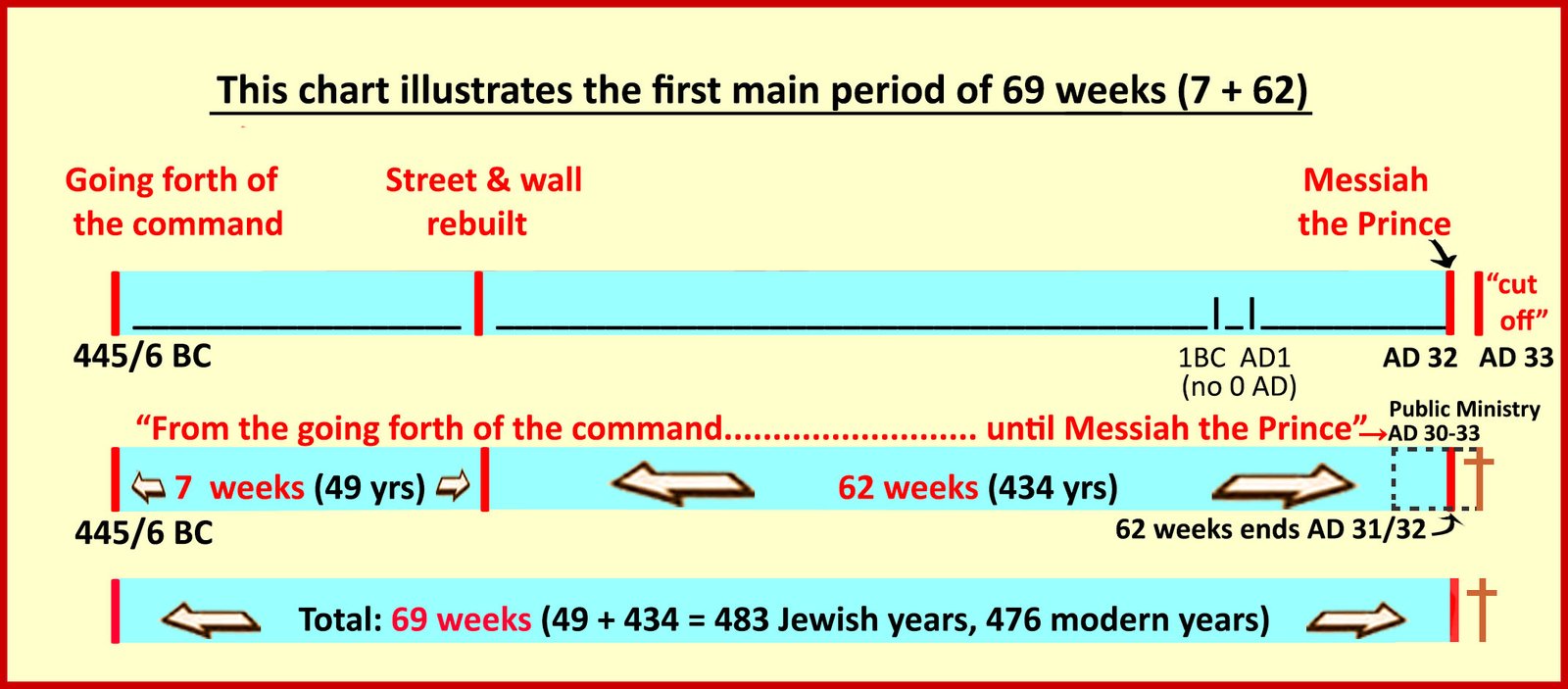
3) A gap of time: Messiah is “cut off” (crucified) AFTER the completion of the 62 weeks. Jerusalem is destroyed and from then on suffers “desolations”. Israel disappears as a nation.
4) 1 week (7 years): As in all of Daniel’s revelations, the prophetic message jumps from an ancient context into a distant future one, the End of the Age. The prophetic message telescopes from the Roman king who destroyed Jerusalem and the temple in ancient times and focuses on his “spiritual descendant” – the Antichrist who comes in modern times to do the same thing.
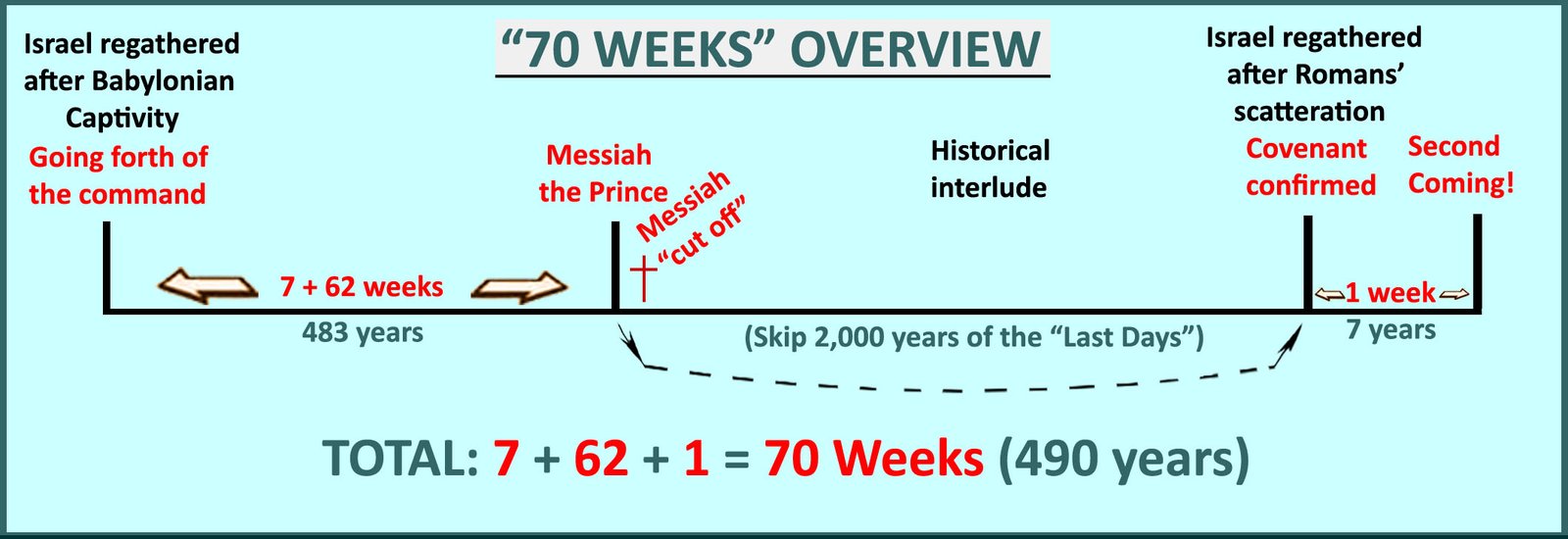
These last 7 years start with the confirming of a covenant by this modern “Antichrist”. The “covenant” appears to be an agreement that allows the Jewish people the religious freedom to continue their worship services in the temple. In the middle of these 7 years, after 3½ years, he invades with an army of “abominations that make desolate”. This sounds like a cryptic reference to modern warfare with its “armies” of drones and vehicles of war. This action results in the halting of religious services. “He shall cause the sacrifice and the oblation to cease.”
From other Scriptures, we can ascertain what happens. One of these desolating abominations enters the temple, and that is what stops religious services. This provocative event signals the start of official worldwide persecution against all true believers. It also signals Christ’s soon return in only 3½ years! The persecution will be for a limited time only. The persecution will be for a limited time, after which God’s judgments on the Antichrist and his followers will be “poured out”. (9:27)
[RETURN TO INDEX]
*
SKELETON OUTLINE OF DANIEL 10 – 12
(Based on the series of Posts Daniel 10-12: Micro/Telescopic View)
DANIEL 10:
- Daniel has spent 3 weeks in fasting and prayer. The Lord appears to him in a form similar to the appearance of Christ in Revelation 1:13-16. This has the same effect on him as it did on John the apostle; he falls into “a deep sleep on my face”. (10:9)
- Then an angel (Gabriel probably) appears to him and says he will reveal to Daniel “what shall befall your people in the latter days”. (10:14) From this we may gather what was the focus of Daniel’s concern: he was praying for his people who at the time were supposed to be re-entering their homeland in Judea, the “Promised Land”.
- The angel informs Daniel that he had to battle with the demon princes of Persia and Greece before he could appear to Daniel. God’s delays are not denials. And we gain some insight into the spiritual realm: nations are ruled by spiritual powers, mostly from the Dark side; and what happens on Earth often reflects what is going on in the Celestial Realm.
DANIEL 11:
- This chapter can be divided into 7 different sections as the angel takes Daniel through different stages of the future history of the Middle East and of Israel.
1) Quick Look at Near-Future History (11:2-4)
- Gabriel’s “telescope” peers quickly through the next 200 years (534-323 BC): Medo-Persia’s history, its collapse before the rising Greek empire, and finally the break-up of Greece into four divisions.
2) Detailed Look at Near-Future History (11:5-20)
- Gabriel’s “telescope” turns into a “microscope” and focuses on the next 150 years (322-175 BC) of wars and turmoil swirling around the land of Judea.
- Of the four divisions of the Greek empire, two of them became major superpowers who were constantly fighting each other for control over Judea: the Ptolemaic dynasty based in Egypt and the Seleucid dynasty based in Syria.
- Israel was ruled by the Ptolemies for about 100 years until the Seleucid dynasty took over in about 200 BC.
- It is an impressive testimony of God’s foresight that enabled the angel to correctly foretell so many future details of Middle East history. Authenticates that what he says about the distant-future will also come to pass.
- The endless series of bloody wars, treacheries, deceptions between the two dynasties exposes how corrupt are the games of power politics that go on in the world. Typical of mankind’s conduct throughout history.
3) Rise of the Antichrist (11:21-22)
- At this point Gabriel’s “telescope” would have focused on the Greek king Antiochus Epiphanes who long ago persecuted the Jewish people in a reign of terror. Verses 21-22 describe the rise to power of this “vile person”: deceptively “by flatteries” followed by crushing all opposition “with the arms of a flood”. This description could apply to both the ancient king and the final Antichrist.
- But the exploits of the ancient king were covered already in chapter 8, so Gabriel’s “telescope” adjusts to a long-distance view of the End-of-the-Age Antichrist, someone who will resemble the ancient king, especially in his obsession with trying to extinguish faith in the true God.
- Mistranslation in verse 22 → much misunderstanding. In ancient Hebrew, the phrase “yea, also the prince of the covenant” is known as a nominal sentence. A better translation would be, “yea, HE IS also the prince of the covenant”. The previous verse 21 introduced a “vile person” who in this verse 22 is identified as the “prince of the covenant”. Gabriel is simply connecting the present revelation to the previous one. The “prince” who “confirms a covenant” (which starts the last 7 years of history) got a brief mention in chapter 9 (verse 27) and re-appears in this new revelation. We are about to learn more about this pivotal End Time figure (who was known also as the “little horn” in chapters 7 and 8).
- From this point on, the passage dwells on events to come. Most commentaries try to interpret the details here in terms of ancient events under Antiochus Epiphanes. However, the events mentioned from here on do not match properly with events in ancient times. The passage is now dealing with distant-future events.
4) First 3½ years of Final 7 Years: Covenant is Made, Major War, Covenant Upsets Antichrist (11:23-30)
- 11:23 – The “covenant” is made, only here it is called a “league”, meaning it is an agreement between warring groups of people, not one between God and humankind
- Several phrases used here were never mentioned regarding the conquests of ancient times (in 11:2-20). Why? because the phrases (in 11:21-35) describe how conquests happen in modern times: 1) “Enter peaceably” – by modern communistic economic strategies and propaganda persuasion techniques 2) “Flatteries” – skillful use of the media 3) “His fathers… nor his fathers’ fathers” – expression that implies a far-distant future 4) “Forecast his devices against the strongholds” – suggests the use of complex modern weaponry.
- “King of the north” (Antichrist) ends up the winner in a war with the “king of the south” (11:25)
- Perhaps these “kings” come from the modern-day nations of Syria and Egypt and Israel, as they did in ancient times, and will be fighting proxy wars on behalf of Russia and America. (Note: “king of the north” could include modern Iraq and Iran, which were part of the ancient Seleucid empire.) From Ezekiel 38-39, it is clear that Russia is the “king of the north” or, at the least, the power behind the “king of the north”.
- The war ends with a hastily arranged peace conference (11:27). Are the kings of north and south afraid of starting a nuclear war?
- The “covenant” is still in effect, but the “king of the north” is unhappy with it, despite having gained a great amount of wealth from the war. He gets angry with it when “ships from Cyprus” come against him
5) Last 3½ years of Final 7 Years: Covenant Broken; Abomination of Desolation; Great Tribulation (11:31-35)
- The anti-Christ “king of the north” sends the “abomination that makes desolate” (an armored tank or drone?) into the Jewish “holy place” (Daniel 11:31, 12:11; Matthew 24:15 and Mark 13:14). This violent desecration of a holy place triggers the era of persecution known as the Great Tribulation. Believers around the world, who refuse to renounce their worship of the Most High, suffer persecution from the forces of the Antichrist. It is a time when the power of God is revealed in remarkable ways through miracles of protection, through the teachings and exploits of God’s people in those final days. It is a time also “to refine” and “purify” God’s people. (11:35, 12:10)
6) Description of the Antichrist “King of the North” (11:36-39)
- The anti-Christ “king of the north” has a spiritual life that reflects the secular humanism of modern times. He does not “regard any god” but “shall exalt himself above them all.” “He shall honor a god of fortresses.” His “honor” (rather than “worship”) of a war god of armaments springs from self-admiration of his own great might and strength of arms. With this kind of spiritual life, it is easy to understand why he wants to “pollute the sanctuary” by sending in the destroying abomination. (11:31)
7) Last 3½ Years (this time, not as to how it affects the people of God, but how it affects the world at large): Great Tribulation Continues, Antichrist’s Wars Against the World (11:40-45)
- Again, as in the “ships from Cyprus” attack, the “king of the south” tries once more to attack the “king of the north”. Or possibly, it is the same attack. “The king of the north shall come against him like a whirlwind.” (11:40) This sounds ominous and could be the time of the destruction of the Great Harlot empire, described in Revelation 17-18. The Antichrist conquers the entire Middle East area, including Israel and Egypt.
- In the wake of this great victory, the Antichrist is able to establish himself in Jerusalem where, as 2Thessalonians 2:4 teaches, “he sits as God in the temple of God, showing himself that he is God.” But the victory is short-lived, for “he shall come to his end, and no one will help him.” (11:45) From other Scriptures, we learn that the Lord Himself enters the Earthly Realm at this point and destroys the Antichrist and False Prophet and their armies in the Battle of Armageddon.
DANIEL 12
- We learn more about the Great Tribulation (outlined earlier in 11:31-35). Here it is called “a time of trouble such as never was since there was a nation”. (12:1) We also learn that Michael the archangel is fighting behind the scenes to protect the people of God – and also, according to Revelation 12, to cast Satan and his forces out of the Heavenly Realm.
- The important news here is that God’s people “shall be delivered” – and in the most remarkable way – by being gathered into the Heavenly Realm. This is known as the Rapture or Resurrection. According to Matthew 24:29, it will happen “immediately after [not before] the tribulation of those days”. And it will spare the “elect” from the final Indignation, the Wrath of God upon the Earth.
- There seem to be two classes of resurrected people: 1) Those who are “wise” and “turn many to righteousness” and are rewarded. 2) Those who are unwise and raised to “shame and disgrace”. (12:2-3)
- Details about conditions in the world at this crucial time in history are given: “many shall run to and fro, and knowledge shall increase”. (12:4) This foretells the great advancements in travel and knowledge that makes the modern world differ so much from the past.
- The revelation is almost finished, and there appear two angelic beings, and another “man clothed in linen”. (12:7) This latter person could well be the same one who appeared at the beginning of this revelation and was also “clothed in linen”. (10:5) This Being makes a solemn declaration of the length of time for the Great Tribulation: “time, times, and an half”. From other Scriptures (Revelation 12:6,14), we know this equals 1,260 days. During this final time period, the Antichrist will “scatter the power of the holy people.” (12:7)
- Although Daniel is told, “go your way… for the words are closed up and sealed till the time of the end” (12:9), Daniel still wants to know more information about the ending of this “time of trouble”. So he is told of two more time periods of 1,290 days and 1,335 days. Not much information is given about them, and since they take place in the future, it is difficult to know with any great certainty what these time periods are meant to represent. One guess, common among Bible teachers, is that the total length of extra time (75 days) represents the time span for the final Plagues (known as the Wrath of God), which are described in Revelation 16. Those who are spared through the Resurrection (or Resurrections?), or who manage to live through that final era will be “blessed”. (12:12)
- At last the angel tells Daniel to go and “rest”. (12:13) His job of receiving this remarkable and long revelation is over. And probably, his time on Earth was almost over as well.
[RETURN TO INDEX]
*
SKELETON OUTLINE OF MATTHEW 24
Jesus Christ’s End of the Age Prophecy (in Matthew 24, Mark 13, Luke 21)
[All Scripture references from the Book of Matthew (NKJ), chapter 24, unless noted otherwise.]
All three chapters (Matthew 24, Mark 13, Luke 21) start with Jesus’ prediction that the Jerusalem temple would be destroyed so thoroughly that “not one stone shall be left… that shall not be thrown down.” (Matthew 24:2) This came to pass, exactly as foretold, when the Romans invaded Jerusalem in AD 70. This startling prediction moved the disciples to ask Jesus when this disastrous event would happen, and connected to it (they thought), what signs would point to His Return and the End of the Age.
Jesus proceeded to warn them against being deceived by those who would pretend to be “the Christ”. He also said much warfare would occur in the future, but they should not “be troubled” for “the end is not yet”. There would also come “famines, pestilences, and earthquakes” but they should realize that “all these are the beginning of sorrows”. (24:4-8)
War has been the scourge of human society since time immemorial, along with “famines, pestilences, and earthquakes”. In each generation, inevitably, some people get “troubled” – wondering if the disastrous events of their time were a sign the End was about to come. Indeed, a number of religious groups have predicted Christ’s coming at a certain date, and then when it didn’t happen, were forced to make an awkward climb-down from their “prediction”.
But we have seen dramatic change take place, in modern warfare especially, which has brought colossal devastation into our world. New and powerful weapons, unimaginable in times past, can inflict extraordinary amounts of death and destruction. We may well wonder then, how can our planet escape self-destruction… unless God intervenes soon? And of course, famines and pestilences are still occurring on a wide scale in spite of modern medical and technological advances.
As for earthquakes, they have been around for a long time. But in the very End, we read in the Book of Revelation of great upheavals, right before the dawn of the new Age of Peace: “There was a great earthquake, such a mighty and great earthquake as had not occurred since men were on the earth… and the cities of the nations fell.” (Revelation 16:19)
Jesus goes on to say that His followers will be persecuted, betrayed, and hated by all nations. This has happened all through history, of course, but will reach a climax just before Christ’s Return. (24:9-10) And He said, “Many false prophets will rise up and deceive many.” (24:11) How true this is in our Modern Age when information spreads around so easily. The false prophets of evolution, communism, atheism, existentialism, transhumanism, and various other isms have sidetracked so much of the modern world into swallowing the false hope that humankind can create some kind of utopian dreamland without God.
Jesus continues, saying, “Because lawlessness will abound, the love of many will grow cold.” (24:12) When laws and rules are no longer followed in society, people and whole nations become selfishly protective of themselves – cold and heartless. Jesus then encourages those who endure and stay faithful in spite of adversity, deception, and a hate-filled social fabric that they will be “saved”. This probably refers to a full Heavenly Reward and a “better resurrection” (as Hebrews 11:35 puts it) – being saved from having to endure “shame and disgrace” (Daniel 12:2) for having failed stay faithful during the time of adversity.
So far, the “signs” have been of a more general nature, but then Christ speaks of signs that focus on the very End of the Age: “This gospel of the kingdom will be preached… to all the nations, and then the end will come.” (24:14) How true that is in our modern world: every nation has had the Gospel brought to it; and in this age of media broadcasting and communication, the Gospel message can so easily jump across borders and spread throughout the world.
And then in the next verse comes an even more specific sign: “the ‘abomination of desolation,’ spoken of by Daniel the prophet, standing in the holy place.” (24:15) At present, the Israelis have no “holy place” in Jerusalem, but it is something that they are eager to construct when the time is right. As for the “abomination”, there are different interpretations as to what this means, most of which convey the idea of it being an idol/image of some kind. This theory is based on the assumption that it can be identified with the “image” spoken of in the Book of Revelation.
But Jesus said we are to go by what was “spoken of by Daniel the prophet”. (24:15, Mark 13:14) An in-depth look at the wording in Daniel 9 and 11 suggests that the “abomination” is not an idol at all but is something that destroys violently, something very different to what existed in ancient times. The phrase “overspreading of abominations” (9:27) sounds like a cryptic reference to modern warfare with its “armies” of drones and vehicles of war. As this “army” invades Jerusalem, one of its desolating abominations enters the temple and puts a halt to religious services.
A modern vehicle of war that storms its way into the Jewish sanctuary, as it is being partially destroyed, would be an accurate fulfillment of this particular sign that Jesus says will come just before His Return. A mechanical monstrosity like this would serve, both as an abomination desecrating a religious sanctuary, and also as something that has the ability to cause violent destruction. This, basically, seems to cover what is meant in the ancient Hebrew by the phrase in Daniel 11:31 “abomination that makes desolate”. The phrases “place” and “set up” in Daniel 11:31 and 12:11 do make it sound like the “abomination” is an idol. But the Hebrew word used here can easily be translated as “send” or “send in”.
And this violent desecration of a holy place triggers the start of official worldwide persecution against all true believers, as well as the start of God’s Judgments on the world of unbelievers. “For then there will be great tribulation, such as has not been since the beginning of the world until this time, no, nor ever shall be.” (24:21) It also signals Christ’s soon return in only 3½ years! Several other Scriptures confirm this short time span for the Great Tribulation era: Daniel 7:25, 9:27, 12:7; Revelation 11:2-3, 12:6 and 14, 13:5.
We can understand, with so much violence and chaos going on, why Christ assures us in the next verse, “And unless those days were shortened, no flesh would be saved; but for the elect’s sake those days will be shortened.” (24:22) During this Gospel Age, Christ’s followers have spread the Good News and have tried to establish godly laws and principles into human society. And for their sake, Jesus will not allow the Devil to rampage in the Earth too long before He gives dominion of the world to His saints.
Sandwiched between the appearance of the “abomination” (24:15) and announcement of the “great tribulation” (24:21), Jesus issues a warning to flee from the coming wave of persecution. Whoever is living in Israel will be the first to feel its effects and will need to flee right away. Presumably, the ripple effect will bring persecution to other places later, so He suggests to pray that “your flight may not be in winter or on the Sabbath”. (24:20) We learn from Revelation 12:6,14 that the Lord will provide places of refuge (in the “wilderness”) where His people can dwell safely.
Incidentally, these few verses (24:16-20) were taken by the early Christians as a warning to flee from Jerusalem ahead of the invading Roman army. Unbelieving Jews, however, thought their temple would save them and ended up getting caught by the Romans. Here we have an example of what could be called a secondary fulfillment of a prophecy. But the ultimate, primary fulfillment is yet to happen in the End of the Age just before Christ’s Return.
Verses 23-26 warn against false and premature proclamations of Christ’s Coming – that He has arrived secretly (“in the inner rooms”) or in a remote area (“in the desert”). Because of heightened expectation for the Second Coming, “false Christs and false prophets will rise and show great signs and wonders.” (24:24) The deception and propaganda will be so thick, even dedicated Christians will find it difficult to avoid being deceived. As for the people of the world, they will be swept along on the False Prophet’s overwhelming tide of propaganda. But Jesus has told us what to expect: “See, I have told you beforehand.” (24:25) When these things begin to happen, those who have paid attention will not be caught by surprise, bewildered. They will be prepared and able to help and teach others.
Verses 27-28 set the record straight: no secret arrival, for Christ’s coming will be “as the lightning” and is compared to how one can see vultures from a distance, circling high in the air; or as a carcass is immediately observed by the vultures and attracts them, so Christ’s coming shall be easily visible. So nothing “secret” about His Coming: “they will see the Son of Man coming on the clouds of heaven… with a great sound of a trumpet.” (Matthew 24:30-31) “And every eye will see Him.” (Revelation1:7)
And this is the climax: Jesus “coming on the clouds of heaven with power and great glory”. (24:30) So momentous is this hour in human history that “the sun will be darkened, and the moon will not give its light; the stars will fall from heaven, and the powers of the heavens will be shaken.” Several times the Bible refers to what happens on this cataclysmic day: Isaiah 13:10, 24:23; Ezekiel 32:7; Joel 2:10,31, 3:15; Amos 5:20, 8:9; Acts 2:20; Revelation 6:12-13.
Another important point to mention here: Jesus lets us know clearly when the gathering of the saints happens – “immediately AFTER [not before] the tribulation… His angels… will gather together His elect.” (24:29,31)
After this momentous revelation about His Return, Jesus continues His discourse, teaching His followers that He can’t answer their question “when will these things be?” (24:3) For “of that day and hour no one knows, not even the angels of heaven, but My Father only.” (24:36)
In the remainder of Matthew 24-25, Jesus offers, in the form of parables, guidance on how to prepare for His Coming:
– The faithful servant and the evil servant (24:42-51)
– The wise and foolish virgins (25:1-13)
– Parable of the talents (25:14-30)
– Son of Man coming to judge the nations (25:31-46)
Regardless of whether we think Christ will return tomorrow or years from now, Jesus exhorts us in these Parables to live each day in communion with and dedication to Him and to do what we can to better the lives of our fellowman.
*
SKELETON OUTLINE OF REVELATION 1
- “Revelation” = Apokalupsis (Greek) = Revealing. Book of Revelation REVEALS Jesus
- Gospels have revealed Jesus in His humble, human, sacrificial form – God’s merciful nature. Revelation reveals Jesus:
1) In blazing glory (1:7-20)
2) As Lord over His people (2:1-3:22)
3) As God’s anger against evil and His forthcoming Judgments, plus Return of Christ to remove usurper Satan and to establish God’s Kingdom on Earth (4:1- 20:15)
4) New Heaven and Earth (21:1-22:21)
- God gave the revelation to Jesus who gave it to His angel who gave it to John who “reported” what he saw and heard so that it could be given to the seven Churches, and from there to all of humanity in the final chapters of the Bible.
- And then we are told, “Blessed is he who reads and those who hear the words of this prophecy, and keep those things which are written in it. (1:3) To study the Book of Revelation is well worth the effort, for through it we understand and are encouraged to know God has a glorious future ahead for planet Earth and will not allow evil to continue to flourish.
- It is interesting to note that both God the Father and Jesus the Son are addressed as “Him who is and who was and who is to come… the Almighty”. (1:4,8) Here we can understand better what Jesus meant when He said, “I and My Father are one.” (John 10:30) We learn also that the Eternal Godhead is not bound by time. And “is to come” – that is, come here to Earth
- John describes Jesus Christ as “the faithful witness, the firstborn from the dead, and the ruler over the kings of the earth” who “washed us from our sins in His own blood, and has made us kings and priests to His God and Father.” (1:5-6)
- John speaks of Christ’s glorious “coming with clouds”, that “every eye will see Him… and will mourn” (1:7) – similar to what Jesus said in Matthew 24:30. The world “will mourn” because they are not ready and they will know that God’s Judgments are about to be unleashed.
- John then quotes what Christ later says about Himself in verse 17, “I am the Alpha and the Omega, the Beginning and the End.” (1:8) Jesus is saying that, as the Creator, He exists beyond time and the Earthly Realm and beyond earthly understanding, which is symbolized by Alpha and Omega, the first and last letters of the Greek alphabet. (An alphabet holds and communicates all human knowledge.)
- John relates how the Book of Revelation started: as a prisoner on the Isle of Patmos, he heard “on the Lord’s Day… a loud voice” commanding him to “write what you see in a book”.
- And what was the first thing John saw (when he “turned to see the voice”)? (1:12) It was the Lord Jesus Christ – the Son of Man in heavenly glory, standing in the midst of “seven golden lampstands… garment down to the feet… girded about the chest with a golden band”, hair “as white as snow… eyes like a flame of fire”, feet “like fine brass… voice as the sound of many waters… in His right hand seven stars, out of His mouth went a sharp two-edged sword, and His countenance was like the sun shining in its strength.” (1:12-16)
- The appearance of Christ in His glorified heavenly form so terrifies and overwhelms John that he “fell at His feet as dead.” But Jesus lays His hand on John and reassures him to “not be afraid”. (1:17)
- Jesus identifies Himself as “the First and the Last… He who lives, and who was dead, and behold, I am alive forevermore” and “have the keys of Hades and of Death”. (1:17-18) With this knowledge, John is assured that this is the same Person whose physical presence he had enjoyed so many years ago. We learn too that Christ has the power to release those who have been imprisoned in the region of Death and Hades, or to imprison those who need to be sent there. As Jesus taught while on Earth, “The hour is coming in which all who are in the graves will hear His voice and come forth – those who have done good, to the resurrection of life, and those who have done evil, to the resurrection of condemnation.” (John 5:28-29)
- Again, John is commanded to “write”. More explicitly, he is to write “the things which you have seen” (the appearance to John of Christ in His heavenly glory in this chapter); “the things which are” (Christ’s “epistles” to the seven churches in chapters 2-3); “the things which will take place after this” (revelation of future history in chapters 4-22). (1:19)
- Jesus goes on to explain the “mystery of the seven stars” as the “angels of the seven churches”. Probably this refers to the guardian angels and the leaders of those churches; and of the “seven lampstands” which a re “the seven churches.” As bearers of God’s Light to the world, they are rightfully symbolized as “lampstands”. (1:20)
MORE “CAPSULES” COMING!
