

1 – Introduction
2 – Mystery of Spiritual Energy
3 – Authority and Dominion of Christ
4 – Problems in Christianity
5 – Origin of the Western Version of Eastern Mysticism
6 – Theosophy’s Early Days
7 – The Name of Christ, or What’s in a Name?
8 – Dark Undercurrents
9 – Return of the Christ
10 – Conclusion
Appendix – What Theosophy Hopes You Won’t Notice
5 – ORIGIN OF THE WESTERN VERSION OF EASTERN MYSTICISM
In the modern western world, knowledge about spiritual energy has dwindled somewhat. This trend began with the Age of Reason, the rise of science, at the dawn of the Modern Age. The thinking of that era tended to squelch belief in the supernatural. There was a well-meaning side to this: the rational desire to discourage superstition. But taken to its extreme, rationalism has caused the collective mindset of humanity to become materialistic, so that the academic world will only accept naturalistic explanations for the mysteries of existence rather than anything that could include the supernatural.
Meanwhile, in the East, especially India, which had remained free of the anti-supernatural tide that was washing over Europe, there was (and still is) a marvelous grasp of spiritual realities, quite opposite to the western mindset.
At the same time the Church was riddled with skepticism and losing its conviction to battle the rising tide of doubts that had begun to creep in. That skepticism was, of course, given a nice name – “higher criticism”. This new field of scholarship treated the Bible as if it were just a collection of myths and fables. Added to this came the rise of Darwinism, which cast doubt on the authority of the Bible to explain the origins of the natural world. (To understand more about the science of Creationism and what is wrong with evolution theory, see the Posts in the Issues series, Retrieving Our Lost Heritage.)
Lurking beneath the veneer of of all this scholarly sophistication, the forces of spiritual Darkness were working overtime to make sure these speculations were heard and swallowed by educationalists, and eventually, by the general public.
For many writers and intellectuals, the Church had become irrelevant, devoid of spirituality, and unable to address the rising tide of skepticism that was sweeping the cultural landscape of that era. It is no wonder then that many of them, in their search for spirituality, and not finding any in the established Church, dove into the spiritualist, occult societies that were springing up all over Europe in those days (1890’s and early 20th century).
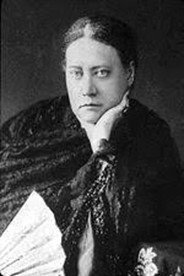
Against this background came the movement of Theosophy. It was led in the beginning by Madame Blavatsky in 1875, followed later by Annie Besant in 1891. Both these ladies sought to introduce Eastern spiritual practices and knowledge to the West and were the founders of the belief system known as Theosophy. Their ideas and writings eventually helped shape the New Age movement. Although relatively unknown today, Theosophy did have a big influence 100 or so years ago, and since the ideas and formulations advanced in Theosophy are now integrated into New Age teaching, it behooves us to study it more closely.
Sadly, neither of these ladies, Blavatsky or Besant, had a desire to honor Christ through their writings:
“For me Jesus Christ, i.e., the Man-God of the Christians… was never a historical person… his story, as told in the New Testament, is an allegory, assuredly containing profound esoteric truths, but still an allegory… The legend of which I speak is founded, as I have demonstrated over and over again in my writings and my notes, on the existence of a personage called Jehoshua (from which Jesus has been made) born at Lüd or Lydda about 120 years before the modern era. (H.P. Blavatsky from “Letter to Charles Webster Leadbeater IX:224-5”)
A shocking statement this. And all the more disturbing coming as it does from a person who is the founder of such a highly esteemed movement as Theosophy. But once in awhile the mask slips off. Instead of the sweet-sounding logic of “official” Theosophy teaching, we get a disturbing glimpse at where that teaching is actually going – to complete denial of the First Coming of Earth’s Savior and future King, Jesus Christ. We see the ugly face hidden behind a veneer of seeming respectability.
“To everything there is a season… a time to break down, and a time to build up,” as the writer of Ecclesiastes expresses it. (3:1,3)
With this in mind, let us try to “break down” – in this case, by separating the teachings of Theosophy from the knowledge of how to use mystical energy for beneficial purposes. Has Theosophy piggy-backed its way on the back of Eastern Mysticism into the modern day? And has Theosophy used that mystic knowledge as a sort of legitimizing agent for what we will have to call a “Dark theology”?
These are good questions to ask for, as the saying goes, the gardener’s duty is not only to love flowers; he must also hate weeds. So let us proceed further with our investigation of the “garden” of Eastern Mysticism… and root out whatever should not be there.
In Blavatsky’s statement above, the term “Man-God” was meant as a put-down, hinting that faith in Christ is a throwback to a primitive era when people were not spiritual enough to conceive of God in any way other than in human, earthly terms. According to her scornful viewpoint, such “primitive” belief should have no place in the realm of the “higher spirituality” that Theosophy likes to champion as the superior attainment of the enlightened person. For Theosophy then, God is a Being disinterested in the human race who wouldn’t think of stooping to our level to appear in human form; so it is just wishful thinking to accept Christ as the Ultimate Ruler.
It’s being “narrow-minded”, Theosophy would say. Open-minded persons would realize that there have been many other “Christs” and Christ-like figures in past religions; yes, Christ was a great teacher, a great human being, but no more than that. But this is looking at things from the wrong angle. Christ is the One who actually fulfilled in Himself what previous religions and mythologies were pointing to, what they imagined the Divine One should be like.
In the years following the Crucifixion and Resurrection and the rise of the Early Church, there arose a number of teachings – known as Gnosticism – similar to Theosophy, which generally tried to deny Christ as having divine status. And instead of relying on Christ for salvation, one only had to gain access to some form of secret knowledge or spirituality.
The opinion by Blavatsky, quoted above, about the non-historicity of Christ is regarded, even by secular historians, as bogus. Not only did Christ live during the first century, but His activities, miracles, death by crucifixion, and Resurrection are based on valid, genuine historical documentation (the Gospels); they are not at all mythological or legendary “stories”.
“I was by now too experienced in literary criticism to regard the Gospels as myths. They had not the mythical taste…. If ever a myth had become fact, had been incarnated, it would be just like this. And nothing else in all literature was just like this.” (Surprised by Joy by C.S. Lewis, 1955)
Ever since the days of the Early Church, various teachers of Gnosticism have tried to figure out, from every angle they could think of, how to deny that Jesus was just who He (and His disciples) said He was, the Son of God and Savior of the world.
Gnosticism from centuries ago and Theosophy in the last century and much of New Age teaching today have sown much confusion about the monumental, staggering truth about who Christ really is – a truth that, by rights, should be in the forefront of everyone’s consciousness. And where, ultimately, does that confusion come from? From the Dark Kingdom, of course – a subject that will be explored further ahead.
In the above quote, Blavatsky concedes that the Gospel accounts contain deep spiritual truths but can’t bring herself to treat them as anything more than myth or allegory. One could go into a long rejoinder here to explain that Christ was a real, historical person, and the Gospel accounts written by the first disciples are true historical documents.
So instead, aside from the above observation by C.S. Lewis, for the interested reader, here are links to a few of several studies from more recent times, detailing the historical validity of the Gospels that are easy to access:
The Case for Christ by Lee Stroebel
The Empty Tomb podcast by Tim Keller
Jesus: Person of Interest podcast by Werner Wallace
