

(First published August 2025; Scriptures from ESV Bible version, unless noted otherwise)
Introduction
1A – First 3 Beasts
1B – The 4th Beast
1C – Son of Man Given Dominion
2 – Angel’s Explanation, Daniel Signs Off
*
DANIEL 7: Introduction
Fifty years had passed since the event recorded in chapter 2 of the Book of Daniel where Daniel reveals to king Nebuchadnezzar the meaning of his dream, his astounding revelation of a great “image”. It was an amazingly simple yet accurate and panoramic outline of future history, starting from the days of the Babylonian empire until the coming of the Messiah to establish God’s Kingdom in the Earth.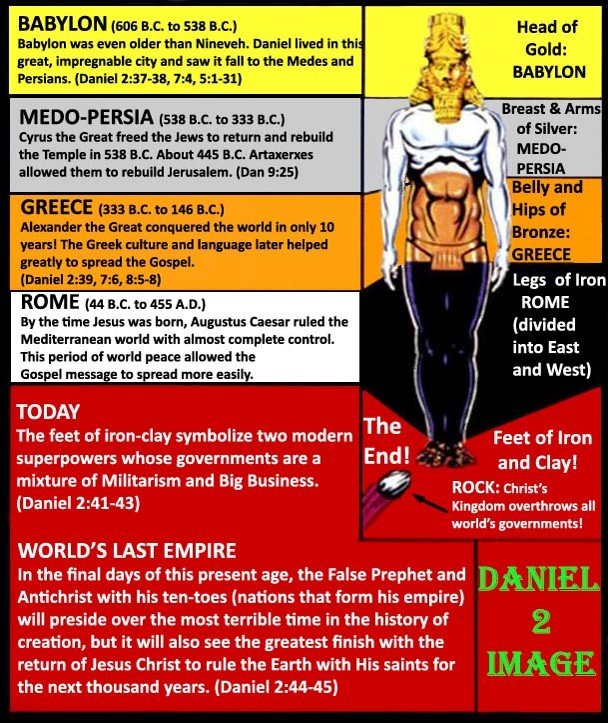
After such a long pause, the time had come for Daniel once more to take up the gift God had given him of receiving dream-visions and recording them. And perhaps to get things off to the kind of kickstart that would keep him engaged, God gave Daniel one of the most vivid and spectacular dream-visions recorded in the entire Bible. Not until the Book of Revelation would there ever appear anything as dramatic and vivid as what is recorded here in chapter 7 of the Book of Daniel. In addition, the dream-vision in chapter 7 links closely to the “image” dream from 50 years earlier (in chapter 2). Only it looks at the same empires from a different perspective and has a lot more to say about events to come at the End of the Age.
*
Daniel Receives a Dream-Vision
7:1 In the first year of Belshazzar king of Babylon, Daniel saw a dream and visions of his head as he lay in his bed. Then he wrote down the dream and told the sum of the matter.
In the first year of Belshazzar king of Babylon
Daniel was careful to note the dates and circumstances of the mysterious revelations that he experienced. “First year of Belshazzar” dates the reception of this revelation in the year 552 B.C. – almost 50 years after the dream about the “image” that both he and the king Nebuchadnezzar had received.
Regarding that former dream, Daniel’s divinely inspired description and explanation of it catapulted him into a position of authority over the wise men of the king’s court and chief minister over the central province of Babylon (2:48); and while in that position, presided over Nebuchadnezzar’s fall from grace (as told in chapter 4) when God allowed the king to think and/or become like an animal for seven years. (After this humbling experience, Nebuchadnezzar without reservation glorified the God of Heaven.) Later, under the Median king Darius, Daniel was made a chief administrator over the Medo-Persian empire’s 120 provinces. (6:1-2)
But this episode in chapter 7 takes place in “the first year of Belshazzar”. Nebuchadnezzar has passed away. Belshazzar has become the new king. And Daniel finds himself out of favor in a regime that mocked and had no respect for the God of the Hebrews. As in his early years as a fresh captive in the Babylonian palace, Daniel again had little or no responsibility.
So for him probably it was like a new beginning. Perhaps he had more time for prayer and meditation, with the result that, what had started 50 years earlier, returned in the form of receiving some amazing Heaven-sent revelations about the future history of the world.
Daniel saw a dream and visions of his head as he lay in his bed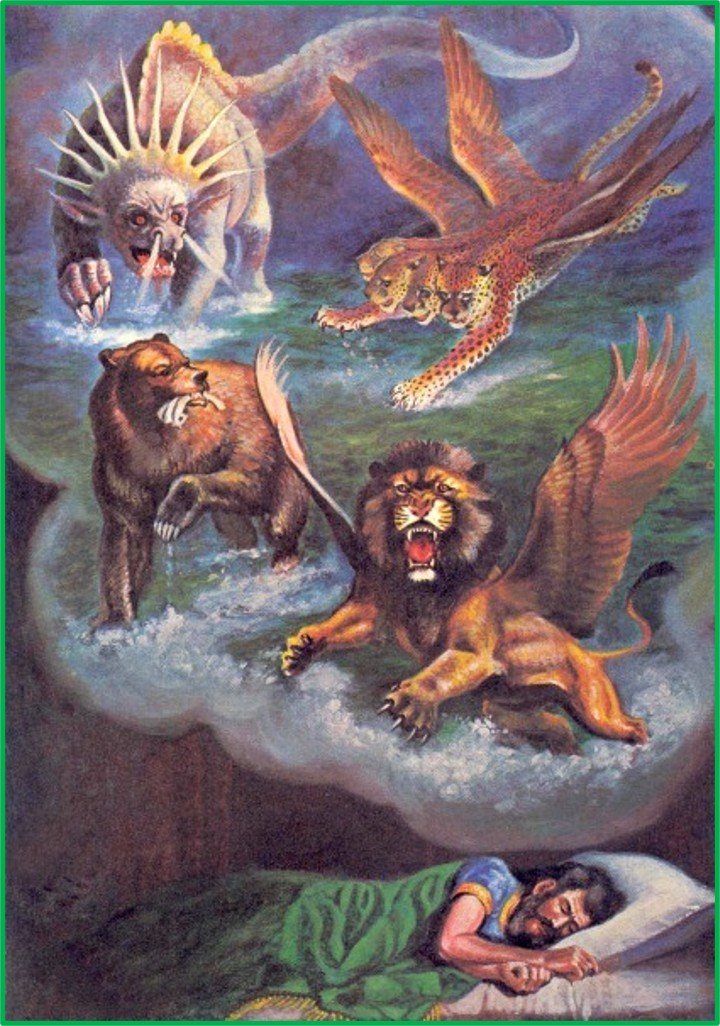
Similar to his experience of 50 years earlier, Daniel experienced an astounding, vivid, eye-popping dream that was destined to echo through the centuries, encouraging and intriguing generations of truth-seekers. But not until our present day has it become possible to greatly expand our understanding of this astounding revelation.
As far as we know, it was mostly a dream – an experience that happens while one is asleep. That is not the same as a vision, which one experiences while in a fully awake state. There seem to be a few scene changes in the course of Daniel’s receiving of this revelation, plus an encounter with a spirit being. So even if this was not a vision in the true sense, as a “dream” it was so vivid that it could almost be counted as such.
Perhaps the Lord was preparing Daniel for the next revelation about two years later. As described in chapter 8, Daniel experienced a real vision then, which included, amazingly enough, a visit from the angel Gabriel to help him understand the vision.
Then he wrote down the dream and told the sum of the matter
The basic outline of what Daniel “wrote” can be divided into two sections: first is Daniel’s description of the different scenes (7:2-14) that passed before him in the “dream and visions of his head;” second is Daniel’s interaction with a spirit being who helps him with the interpretation of the dream (7:15-27)
Half the reason Daniel was given this and other revelations is simply because he was capable of recording them. Likely, his job and educational experience had required him to get into the habit of writing things down. And, of course, why should God send anyone anything of a revelatory nature if the receiver won’t record or make use of it?
The other half of the reason for Daniel’s receiving the revelation had to do with his great love for God and desperate desire to seek and understand His plan for the future. And God answered Daniel’s seeking spirit with amplified answers that went well beyond the future of the Hebrew nation. God revealed His plan for all His people in all nations, especially in the End of the Age era. It was a basic outline of how future world history was going to unfold.
God is so generous and often gives us way more than what we had originally bargained for.
Daniel was able to tell “the sum of the matter”. That is, he reported the chief contents, but perhaps not every last detail, which, since it was a dream, would have been difficult. In subsequent revelations (in chapters 8, 9, 10-12) it was different. The angel Gabriel appears and speaks directly to Daniel. In this way Daniel, being in a conscious state, could record some remarkably accurate details.
Nevertheless, by writing down “the sum” of what he saw, Daniel successfully preserved the inspired revelation that we have here in chapter 7 (which did include quite a few details). The result? When the events foretold in the revelation begin to unfold, it will serve as a reliable guidepost and preparation for upcoming generations. Those who will have to struggle through those perilous times pictured in the revelation will have the comfort of knowing that God already knows what‘s going to happen and thus, He is the one in control. They can count on His promise of deliverance and victorious ending.
For some further clarification and details regarding this portion of the text, see Appendix.
*
7:2 Daniel declared, “I saw in my vision by night…”
This phrase “I saw in my vision by night” is repeated in verses 7 and 13 and seems to divide the first part of Daniel 7 (the dream-vision) into three parts. For the entire chapter of Daniel 7, here is a
TABLE OF CONTENTS
INTRODUCTION
7:1 Date and historical setting of the dream-vision
PART 1 – THE DREAM-VISION
- 7:2-6 First three Beasts (empires)
- 7:7-12 Fourth Beast (empire) and its overthrow
- 7:13-14 Messiah’s Kingdom
PART 2 – INTERACTION WITH SPIRIT BEING AND EXPLANATION
- 7:15-18 Spirit being offers a brief explanation of the dream-vision
- 7:19-22 Daniel re-states what he had seen of the “fourth beast” while requesting further insight about it
- 7:23-27 Spirit being offers more information about the “fourth beast”
CONCLUSION
7:28 Daniel is bewildered
This whole dream-vision in chapter 7 could be compared to a theater production. There are several scenes in this drama, each depicting certain features about future history. The action takes place in both Earthly and Celestial Realms, and focuses on the final events of the present Age.
*
Continue to “Daniel 7:2-6, First Three Beasts“
APPENDIX
[Daniel] made a record of it at the time. He did not commit it to tradition, or wait for its fulfillment before it was recorded, but long before the events referred to occurred he committed the prediction to writing, that when the prophecy was fulfilled they might be compared with it. It was customary among the prophets to record their predictions, whether communicated in a dream, in a vision, or by words to them, that there might be no doubt when the event occurred that there had been an inspired prediction of it, and that there might be an opportunity of a careful comparison of the prediction with the event. Often the prophets were commanded to record their predictions. See Isa 8:1,16; 30:8; Hab 2:2. Compare Rev 1:19; 14:13; 21:5… and as there is all the evidence… that the record has not been altered to adapt it to the event, the highest proof is thus furnished of the inspiration of the prophets. The meaning here is, that Daniel wrote out the dream as soon as it occurred.
That is, he spake or told them by writing. He made a communication of them in this manner to the world. It is not implied that he made any oral communication of them to anyone, but that he communicated them – to wit, in the way specified. The word “sum” here – ree’sh (OT:7389) – means “head”; and would properly denote such a record as would be a heading up, or a summary-as stating in a brief way the contents of a book, or the chief points of a thing without going into detail. The meaning here seems to be that he did not go into detail – as by writing names, and dates, and places; or, perhaps, that he did not enter into a minute description of all that he saw in regard to the beasts that came up from the sea, but that he recorded what might be considered as peculiar, and as having special significancy.
…the prophets, when they described what was to occur to tyrants in future times, conveyed their oracles in a comparatively dark and obscure manner, yet so as to be clear when the events should occur. The reason of this is obvious. If the meaning of many of the predictions had been understood by those to whom they referred, that fact would have been a motive to them to induce them to defeat them; and as the fulfillment depended on their voluntary agency, the prophecy would have been void. It was necessary, therefore, in general, to avoid direct predictions, and the mention of names, dates, and places, and to make use of symbols whose meaning would be obscure at the time when the prediction was made, but which would be plain when the event should occur…
(from Albert Barnes’ Notes on the Whole Bible, published in the 1800’s)
*
