

Introduction
1A – First 3 Beasts
1B – The 4th Beast
1C – Son of Man Given Dominion
2 – Angel’s Explanation, Daniel Signs Off
*
1B – DANIEL 7: Daniel’s Vision of the 4th Beast (7:7-12)
Having seen the Beasts that represented Babylon, Medo-Persia, and Greece, the Lord now turns Daniel’s attention to the next and final Beast.
*
7:7 After this I saw in the night visions, and behold, a fourth beast,  terrifying and dreadful and exceedingly strong. It had great iron teeth; it devoured and broke in pieces and stamped what was left with its feet. It was different from all the beasts that were before it, and it had ten horns.
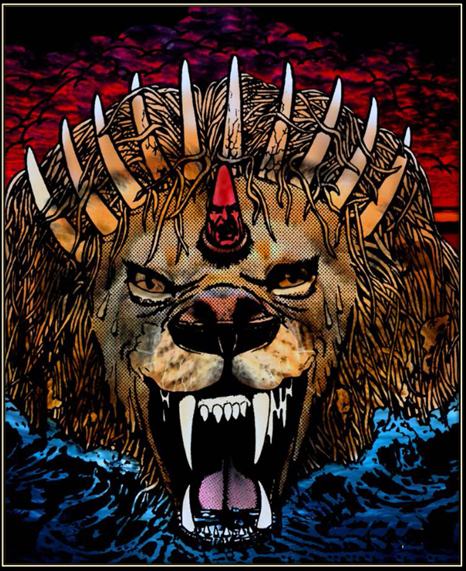 terrifying and dreadful and exceedingly strong. It had great iron teeth; it devoured and broke in pieces and stamped what was left with its feet. It was different from all the beasts that were before it, and it had ten horns.
*
After this I saw in the night visions
This repeats the phrase from verse 2: “I saw in my vision by night,” and brings us into the second episode of the vision. This phrase “I saw in the night visions” suggests that Daniel had experienced a pause, woke up perhaps, and had opportunity to write down what he had just seen. Then he returns to his “sleep” or dream mode or whatever it was to continue receiving the next episode of his “night visions”.
Behold, a fourth beast
At this point the scene shifts dramatically as God’s camera zooms in for a close-up look at the next “beast”. Compared to the other Beasts, the dream goes to much greater lengths to reveal the characteristics and activities of this “fourth beast”.
Prophecy most dwells on the end, which is the consummation of the preceding series of events. It is in the fourth that the world-power manifests fully its God-opposing nature. (from Commentary, Critical and Explanatory on the Whole Bible by Jamieson, Faussett, Brown – 1871)
And it is during the reign of the “fourth beast” that Christ reveals Himself: first as the suffering Savior in Roman times and then, centuries later, as the conquering Deliverer in modern times.
Following the Greek empire came the Roman empire. The fact that it is designated as the “fourth beast” is significant, for that links it with the “fourth kingdom” of the “image” dream seen by Daniel and Nebuchadnezzar 50 years earlier (2:40). And perhaps this was the Lord’s way of “continuing the story” that began so long ago when Daniel was a young man. 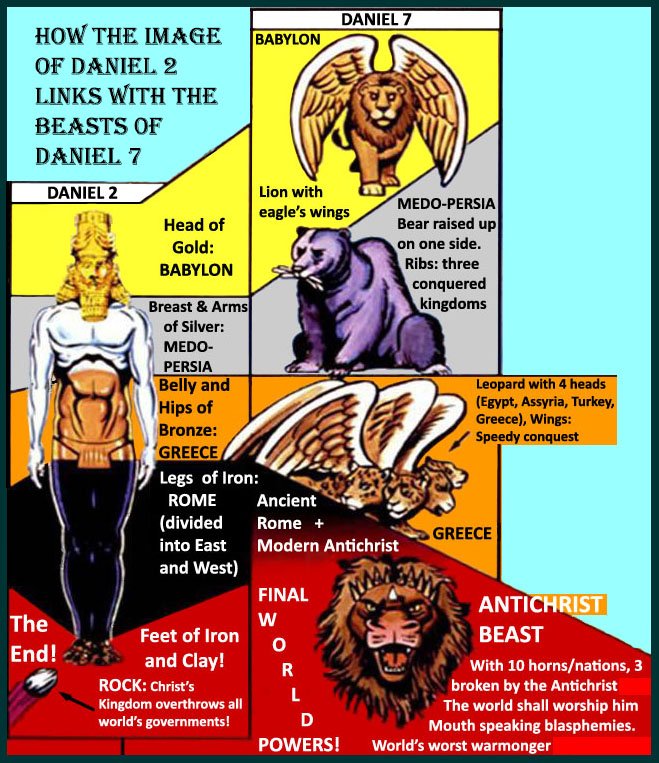
In that first dream of his, the “fourth kingdom” spanned both legs and feet of the “image”, showing that the single “fourth kingdom” actually represents two empires (and two territories): firstly, the ancient Roman empire of the “legs” with its European and Asian divisions; and secondly, the final modern empire of the “feet”, which looks like is going to be Eurasia, divided along similar lines (between Europe and Asia). (See the Capsule Summary post “The final Empire: Revival of Rome?” for more information on that subject.)
In the dream of chapter 2, the Lord foretells certain aspects of the basic geo-political structure of the final empire. Now here in this new vision, He offers a more detailed look at this final empire and its demagogue leader, whose overthrow will usher in God’s Kingdom on Earth.
Since the body parts of the “image” in chapter 2 match with the “beasts” here in chapter 7, then logically, this “fourth beast” should match with the “fourth kingdom” in chapter 2. And since it is clear that this “fourth kingdom” represents two empires, ancient and modern (symbolized by the legs and feet of the “image”), then the “fourth beast” should also symbolize both ancient and modern empires. And this becomes all the more obvious as we read the embellished description of this Beast who – with its “ten horns”, “iron teeth”, and “bronze claws” – “devours the whole earth”. These features extend well beyond the activities of the ancient Roman empire.
Rome was the last empire to rule over Israel before it was dismantled and scattered by the Romans. But now that Israel has re-appeared on the world stage, the situation is ripe for Israel again to come under the yoke of a new “beast” empire – one that will possess the kind of “iron” military strength that characterized ancient Rome and is like an expanded version of the same.
With this fourth and last beast kingdom we Europeans of the present day are most concerned. For we live under it; our civilization, language, constitution, laws, and politics being essentially connected with imperial Rome. Indeed, the Germanic empire and the Russian empire expressly profess to represent the western and eastern Roman empire respectively. The title of the Russian emperor is czar, a contraction for Caesar. Out of its ten kingdoms (Dan 7:7-8) springs the Antichrist, with eyes like the eyes of man – that is, with the high intellectual culture of man seemingly, while really and essentially beastly, as being severed from God. (from Commentary, Critical and Explanatory on the Whole Bible by Jamieson, Faussett, Brown – 1871)
As in chapter 2, the fourth stage of empire is Roman. Since this kingdom must prevail until the destruction of Antichrist (the little horn) and the establishment of the eternal, final, visible kingdom of Christ (cf. Rev 19:11-20:4), it must be regarded as prevailing today. The ten-fold form of the final stage, perhaps suggested by the ten toes of chapter 2, is clearly taught here and confirmed by Rev 17:3 ff. Later in the chapter the little horn is identified with final Antichrist. (from The Wycliffe Bible Commentary, published 1962 by Moody Press)
Terrifying and dreadful and exceedingly strong… great iron teeth
Truly, this describes the ancient Roman empire, with its well-organized government and military forces that controlled the major part of Europe, western Asia, and northern Africa. And this strong military presence will be a major feature also of the final empire. “Who is able to make war with him?” (Revelation 13:4, NKJV)
“And it had great iron teeth.” Not only teeth or tusks, such as other animals may have, but teeth made of iron. This is characteristic of a monster, and shows that there was to be something very peculiar in the dominion that was here symbolized. The teeth are of use to eat or devour; and the symbol here is that of devouring or rending – as a fierce monster with such teeth might be supposed to rend or devour all that was before it. This, too, would denote a nation exceedingly fierce; a nation of savage ferocity; a nation that would be signally formidable to all others. (Albert Barnes’ Notes on the Whole Bible, published in the 1800’s)
These “great iron teeth” reflect the description in chapter 2, verse 40, about the “iron” characteristic in the “legs” of the image. “Iron” is the feature about ancient Rome that continues on into the final “feet” empire of modern times. For more information on this, see post “How Iron Continues into the Modern World”.) And later on, we read about the “claws of brass”. (7:19)
It was a beast more terrific in its appearance than either of the others, and was evidently a monster such as could not be designated by a single name. The terms which are used here in describing the beast – “dreadful, terrible, exceedingly strong,” are nearly synonymous, and are heaped together in order to give an impressive view of the terror inspired by the beast. There can be no doubt as to the general meaning of this, for it is explained (Dan 7:23) as denoting a kingdom that “should devour the whole earth, and tread it down, and break it in pieces.” As a symbol, it would denote some power much more fearful and much more to be dreaded; having a wider dominion; and more stern, more oppressive in its character, more severe in its exactions, and more entirely destroying the liberty of others; advancing more by power and terror, and less by art and cunning, than either. This characteristic is manifest throughout the symbol. (Albert Barnes’ Notes on the Whole Bible, published in the 1800’s)
We should note the fact that these commentaries were written long before the colossal destructive power of modern weapons had been invented. Nowadays, we can see more easily how Rome’s emphasis on its military culture would grow in modern times through advanced war technology. This is apparent in the embellished description of the “fourth beast” as noted in verse 7.
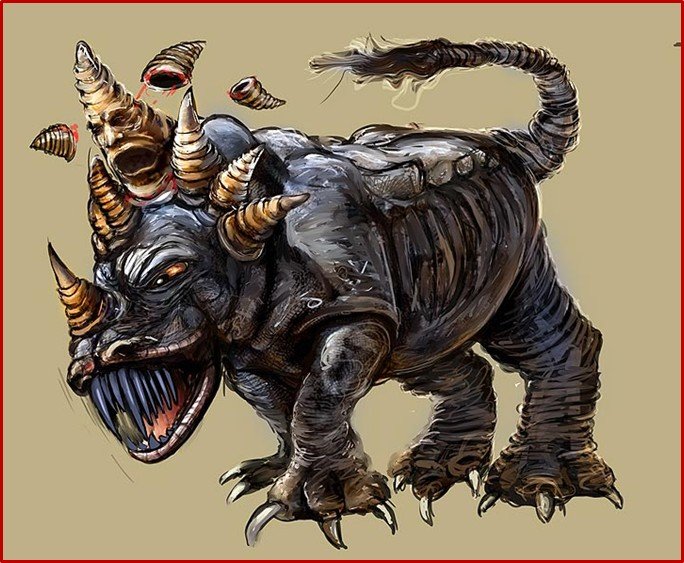
It devoured and broke in pieces and stamped what was left with its feet
In addition to that [the “iron” of Daniel 2 and the “iron teeth” of Daniel 7], there are also feet, or, as v. 19 by way of supplement adds, “claws of brass,” with which in the mere fury of its rage it destroyed all that remained, i.e., all that it did not devour and destroy with its teeth. (from Keil & Delitzsch Commentary on the Old Testament, 1864)
Further ahead, an angel or spirit being appears and explains more about the vision, and he adds the important detail that this “fourth beast” will “devour the whole earth”. (7:23) This was something the Roman empire was unable to do. China, India, and most of Africa lay outside its boundaries. And of course, the Americas were unknown at that time in history. So here is an indication that the prophetic message is reaching beyond ancient Rome into a distant-future version of the “fourth beast” – the version that matches with the “feet” of the “image” in chapter 2.
Of course, we may wonder, how can such a global conquest ever transpire? Well, we know that it is possible, with the advent of modern technology, for rulers to gain an incredible amount of power and control. But the question we might ask, who exactly are going to be the masters of the world of the near future? Well, that is a huge subject that is covered in other posts on this website.
Without going into a lot of detail, here is a brief summary of how this website envisions the unfolding of the world situation during these tumultuous years of the End of the Age. To start, we observe nowadays the Eurasian land mass getting united as the nations of Russia and China rise up to challenge the power bloc of Western nations (headed by the United States of America) that has dominated the Earth in modern times. (The series of posts in Daniel 2: Shape of the Future and Fall of the Great Harlot offer a good deal of information on this subject.)
The Book of Revelation refers to the Western nations in chapters 17-18 as the empire of the Great Harlot and goes on to describe her catastrophic collapse at the hands of the Beast and his Ten Horns. This resembles what happened to the ancient Israeli nation during the Assyrian, Babylonian, and Roman invasions. She also had become a “harlot” in the eyes of God – full of injustice and oppression and committed to the worship of other gods.
Passages in Revelation 17:17; 18:8,20; 19:2 make it clear that God allows and even makes sure that the modern Harlot empire receives a similar catastrophic judgment. These chapters also explain why: like ancient Israel, America has become badly corrupted and exported her corruption into the rest of the world. And to continue living in luxury, she has strangled the world economically and brought military devastation to those nations that tried to get out from under her control. (See Revelation 18:3,5,7,23-24.)
Because she hypocritically claims to be the standard bearer of Christianity, yet behaves so badly on the world scene, it is no wonder that in chapter 19 we see Heaven rejoicing over the collapse of this society that has done so much damage to the peoples of the world, and in the process, besmirched the Name of God in the Earth.
“Rejoice over her, O heaven, and you saints and apostles and prophets, for God has given judgment for you against her!”… I heard a loud voice of a great multitude in heaven, saying, “Alleluia! Salvation and glory and honor and power belong to the Lord our God! For true and righteous are His judgments, because He has judged the great harlot who corrupted the earth with her fornication; and He has avenged on her the blood of His servants shed by her.” Again they said, “Alleluia! Her smoke rises up forever and ever!” (Revelation 18:20, 19:1-3)
To bring about the military defeat of a powerful empire like the American Harlot, it looks as though God is allowing the nations of Russia and China to rise up in opposition to her. Indeed, it will require the kind of extraordinary warlike capacity that Russia already possesses, as illustrated for us in the vision of the “fourth beast” in this verse 7 (also in verses 19 and 23).
With America defeated and destroyed, the Eurasian landmass will then be in position to rule the entire world. And it helps to understand that its dominance won’t have to rely only on the “fourth beast’s” military prowess. Because of China’s industry and infrastructure-building all across Asia towards Europe, the final empire will be positioned to dominate the earth economically, not just militarily.
It will be extremely difficult in those days for nations to escape the long arm of what Revelation 13 pictures about the two Beasts from “sea” and “earth”, those powerful empires headed by the Antichrist and False Prophet.
And not just for nations, but for individuals too. Those who refuse to give in to the false worship system of those days will find themselves under great duress by the world system. But they will be highly honored by the Lord in those future days when “the meek shall inherit the earth.” (Psalm 37:11, Matthew 5:5)
With this new and upcoming global empire established, the Devil will finally get what he’s always wanted – full control over the world. Flush with its success in war, the new empire of the Beast will go on a rampage, unable to restrain himself in the wake of their smashing victory over the Great Harlot empire. And it too will turn into an oppressive and tyrannical regime and will make a huge mess of things.
This empire, which will claim not to worship God, will end up being just as corrupt and tyrannical as was the Harlot empire, which claimed to worship God, but in practice did not. And in both cases, the reason for their failure is the same: under provocation and influence from the forces of spiritual Darkness, they became unwilling to give heed to the voice of God, nor even to godly principles of justice and mercy.
Like a fierce monster, whatever it could not devour it stamped down and crushed in the earth. This indicates a disposition or purpose to destroy, for the sake of destroying, or where no other purpose could be gained. It denotes rage, wrath, a determination to crush all in its way, to have universal dominion; and would be applicable to a nation that subdued and crushed others for the mere sake of doing it, or because it was unwilling that any other should exist and enjoy liberty – even where itself could not hope for any advantage. (Albert Barnes’ Notes on the Whole Bible, published in the 1800’s)
This sounds exactly like the policy and predisposition of the present Harlot empire – “a determination… to have universal dominion”. It is ironic that the powers who now oppose the Harlot and wish to establish a multi-polar world order will, apparently, come full circle. They will become just like the corrupt empire that they overthrew. Well, this is not surprising. It is the same old tactic that the forces of spiritual Darkness have followed since time immemorial: to worm their way into the useful and beneficial ideas, inventions, and new organizations of humankind and corrupt them to serve an evil purpose of some kind or other.
So, like the Harlot empire, the “fourth beast’s” empire will become corrupted and is also doomed to defeat. But at this point in history, since no nations will be strong enough to challenge the combined regimes of Sea and Earth Beasts, no nation capable of resisting their final government, then the Lord Himself will have to do it. And so it will be that Christ and the armies of Heaven will descend in the Battle of Armageddon to destroy the Antichrist and False Prophet Beasts and their armies.
It was different from all the beasts that were before it
The previous three Beasts were pictured in the form of certain recognizable animals – lion, bear, leopard – but this “fourth beast” is “different” in that it can’t be compared to any known animal. It is just described as “terrifying and dreadful and exceedingly strong”, with the peculiar features of ten horns, a little horn, iron teeth, and claws of bronze.
Ancient Rome differed from previous empires in its republican form of government. But otherwise, Rome was not that much different from the regimes and cultures that had gone before. Their army used the same basic type of weapons as others had. Their religion made use of idols, just as previous cultures had; in fact, their gods were borrowed from the Greek pantheon of gods, and were just given Latin names.
So what makes the “fourth beast… different”? Like the “fourth kingdom” in chapter 2, this “fourth beast” extends into modern times. As a result that will cause it to exhibit huge differences. Advanced modern technology multiplies enormously our military capacity for destruction, the speed of our communication and propaganda systems, the computing power of artificial intelligence. As a result we have today unimaginably powerful weapons, self-powered vehicles, electrical energy, broadcasting technology, and the list goes on.
And some other good reasons, from Biblical references, as to why this Beast seemed “different” has to do with these peculiarities:
- The “fourth beast” straddles both ancient and modern times.
- And what is even more odd is the fact that the modern version of this Beast is actually two Beasts in one; as pictured in Revelation 13, one Beast comes out of the “sea”, while the other comes out of the “earth”. And these are portrayed later as being combined: “And the beast that was, and is not, even he is the eighth, and is of the seven.” (17:11) (For more information on that point, see Post “Eighth Head”.)
- The culture of this modern empire is non-superstitious and scientific. Instead of worshiping idols, modern society has adopted a different belief system, what we might call the “religion” of secular demagoguery, as suggested in certain passages: “he shall exalt himself and magnify himself above every god… pay no attention to the gods of his fathers… to any other god, for he shall magnify himself above all…” (Daniel 11:36-38): “who opposes and exalts himself against every so-called god or object of worship” (2Thessalonians 2:4).
- In the Book of Revelation, the final Beast is given this description: “like a leopard, with the feet of a bear and the mouth of a lion.” (13:2) It is described there also as having “seven heads”. It appears then that this final Beast will inherit the wisdom and power of its previous “heads”. So a major reason for its difference from the other Beasts lies in the fact that it combines in itself features from the previous empires that once controlled Israel.
Another reason why this Beast “was different from all the beasts that were before it,” lies in the fact that both the Roman empire and final empire have a system of government that is based on republicanism. This kind of governing authority differs from the monarchical system, which, until Rome came along, was the generally practised form of government. Although some of the early Greek states practised a form of Republicanism, the Greek empire under Alexander, and afterwards, the four heads of the Greek Leopard were run by family dynasties. Republicanism didn’t begin in earnest until the advent of Rome. And in different ways this form of government (without a hereditary monarch) is practised in every nation of our world today. (See post “How Iron Continues into Today’s World”.)
The advantage of Republicanism lies in the fact that it allows capable and competent rulers to come to the fore; governance isn’t restricted by the ascent of a powerful monarch who may or may not be skilled in the art of administration. However, the disadvantage of republicanism is that it can be too easy for scheming persons of evil intent to rise to power.
And it had ten horns
The Ten Horns of the “fourth beast” were prefigured in Daniel’s earlier vision of the “image” with its ten toes. (2:41-42). The Ten Horns feature of this Beast is mentioned no less than seven times in the Bible: three times here in Daniel 7 and, 600 years later, four times in the Revelation Book. (Daniel 7:7,20,24; Revelation 13:1, 17:3,12,16) This oft-repeated detail suggests, of course, that whenever they show up on the world scene, this will serve as a clear sign that the End of the Age is near.
Furthermore, these Ten Horns are one of those peculiar and crucial details that will help us to pinpoint which superpower this final Beast represents. The same was true for the other Beasts in Daniel 7. Their peculiar features – the lion given a man’s heart, the bear raised up on one side, the leopard with four wings and four heads – make it easy to identify who those Beasts were – the Babylonian, Medo-Persian, and Greek empires.
Actually, we don’t even need this “ten horns” feature to know who the final warlike superpower is going to be. The prophetic message in the Book of Ezekiel, chapters 38-39, clearly pinpoints the Russian Federation in this role. (There are several details to consider here, and these may be found in the Ezekiel 38-39 series of posts.)
But to add more certainty to solving the mystery of this final Beast’s identity, we can look at this intriguing “ten horns” feature and apply it quite easily to the Russian Federation. The remarkable feature about Russia is that she is actually part of a larger organization called the Commonwealth of Independent States. This organization started off with 11 nations – Russia plus 10 smaller republics.
Although some are trying to pull away, Russia is even now in the process of bringing these rebellious republics back in line. And this seems to be accounted for here in chapter 7: “three of the first horns were plucked up by the roots… shall subdue three.” (7:8,20) Anyway, this is a very big subject, with several more details to consider, and is covered more thoroughly in the post “Ten Horns Coming into View?”
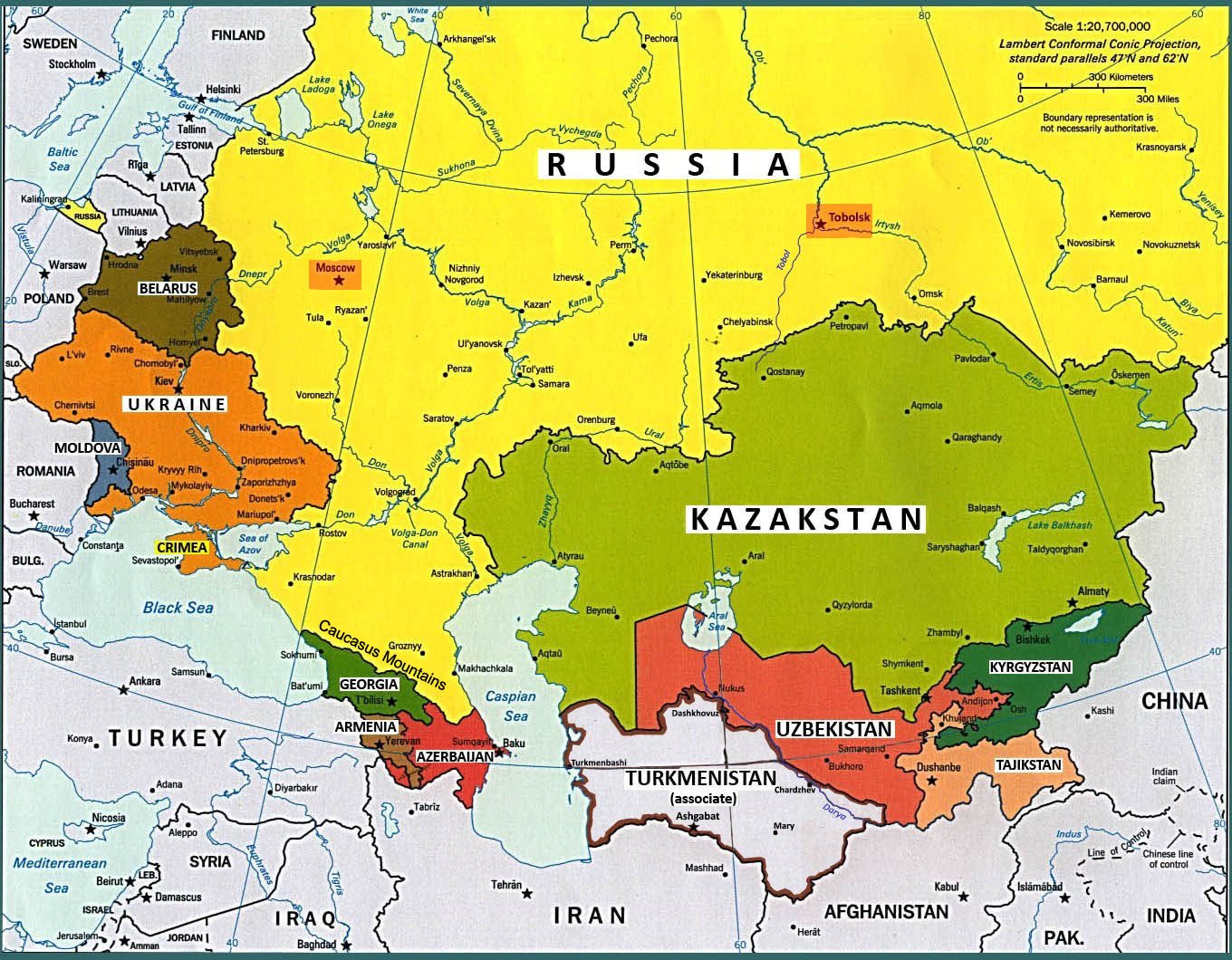
Now there is a difficulty in this passage about the “fourth beast”. How can the Ten Horns be satellite nations around the nation of Russia when it is so distant in both time and space from ancient Rome? This seeming discrepancy is addressed in Appendix 2 of the above-mentioned post, “Ten Horns Coming into View?” and in the Capsule Summary, “The Final Empire: Revival of Rome?”
The problem is simple and can be explained in a brief summary. Viewing the modern Beast as connected to the ancient Roman empire seems logical from the description of it in Daniel 7. But when we factor in the information from chapter 2, a larger picture emerges. The two legs of the “image” symbolize the geographical situation of ancient Rome divided by its two main territories: Europe in the west and Asia in the east. And as feet are extensions of the legs, so we should expect that the same geographical division continues into the modern day feet portion of the “image”.
And this is exactly what we see happening now. The growing Eurasian empire is divided between the European side (European Russia and maybe Europe) and the Asian side (China, the Middle East, India, SE Asia). That is a much larger territory than ancient Rome, yet it is how “ancient Rome” re-appears on the modern scene – the same basic division, but greatly expanded.
So there is no need to geographically link the Ten Horns to ancient Rome. This was a bit of a stumbling-block in times past, and this made it difficult to link ancient Rome with the final empire. But there is no need to cast the Ten Horns in the role of being some kind of geographical connection to the ancient empire. Furthermore, how can the toes come out of the legs of the “image” (ancient Rome), when they can only come out of the feet (the modern empire)?
Besides the Ten Horns serving to identify who is the final Beast, there is a certain numerological significance about this number 10:
The number ten comes into consideration only according to its symbolical meaning of comprehensive and definite totality. That the horns are on the head of the one beast, signifies that the unfolding of its power in the ten kingdoms is not a weakening of its power, but only its full display. (from Keil & Delitzsch Commentary on the Old Testament, 1864)
Ten is the number of worldly completion, especially in the line of worldly evil. (from The Apocalypse, Lectures on the Revelation of Jesus Christ by Joseph Seiss – 1913)
*
7:8 I considered the horns, and behold, there came up among them another horn, a little one, before which three of the first horns were plucked up by the roots. And behold, in this horn were eyes like the eyes of a man, and a mouth speaking great things.
I considered the horns, and behold, there came up among them another horn, a little one
Although we are still in the same episode of dream-revelation, this phrase “I considered… and behold” does signal a scene change as God’s “camera” zooms in for a closer look at a peculiar feature of the “fourth beast”, its “little horn”. All through history, empires rose to dominance under the leadership of a charismatic and powerful ruler. For example, Nebuchadnezzar, Cyrus, Alexander were leaders of Babylon, Medo-Persia, Greece respectively. We should expect then that the final empire will also be led by a powerful strongman.
For the Beast symbolism represents, not only the empire, but its emperor as well. The one cannot do without the other. (See this explanation “Head=Beast? King=Kingdom?”) So at this point the prophetic message zooms in for a closer look at the “emperor” aspect of the Beast – the powerful ruler, symbolized as a “little horn”, coming in these final days of human history.
We can look at the example of Nazi Germany, which rose to power under the Hitler strongman. Without Germany, Hitler was just a big loudmouth. Without Hitler, though, Germany lay demoralized and struggling in the wake of their defeat in World War 1. But with Germany under his command, Hitler raised the nation to become the dominant power in Europe.
Germans needed a charismatic leader to galvanize their nation, a strongman who could unite the people and stand up to their perceived enemies. Likewise, the “little horn” (with eyes and mouth) will galvanize the world in opposition to their perceived enemies – first of all, against the corrupt Harlot empire (America), followed later against the forces of God.
He “considered the horns;” that is, he looked on them until another sprang up among them. This implies that when he first saw the monster, it had no such horn, and that the horn sprang up a considerable time after he first saw it – intimating that it would occur, perhaps, far on in the history of the kingdom that was symbolized. (Albert Barnes’ Notes on the Whole Bible, published in the 1800’s)
The present leadership in Russia did not emerge until after the formation of the 10-nation Commonwealth of Independent States. By the way, that doesn’t mean to imply that Vlademir Putin is the Antichrist. Since he’s not uttering “blasphemies”, then that seems to disqualify him from that role. More likely is the possibility that the role of Antichrist will be given to someone coming after him. But Putin is preparing the way – by his work of strengthening Russia and making the nation independent of the Harlot world system.
It sprang up “among” the others… the others stood close together, and that this sprang out of the center, or from the very midst of them – implying that the new dominion symbolized would not be a foreign dominion, but one that would spring out of the kingdom itself, or that would seem to grow up in the kingdom. (Albert Barnes’ Notes on the Whole Bible, published in the 1800’s)
The picture we get is that the “little horn” and the “ten horns” are all part of the same closely connected group of nations. Which reflects pretty well the present day grouping of Commonwealth of Independent States. (See the post “Ten Horns Coming into View?” for more information.)
As for why the Horn is called “little”, that is a mystery. If anything, we would think he should be called “big”. But he’s not. And why he’s not is difficult to understand. The characterization of him as a “little horn”, however, re-appears in chapter 8: “Out of one of them came a little horn.” (8:9) Further ahead, Daniel explains that the horn “seemed greater” than its companions. (7:20 – ESV, NLT) In both chapters 7 and 8, the Little Horn is pictured as powerful, but also as cruel and unprincipled and full of inflated ego. If the characterization of “little” refers to the Horn’s moral stature, then that would fit.
Another plausible explanation: the leader starts out as “small”, having perhaps a minor position in the 10-horned empire. He later on rises to prominence and leadership in the Beast empire and over its Ten Horns. If so, this would reflect how some of his ancient precursors rose to power. The ancient Seleucid “king of the north” started as an official in the Ptolemaic empire before becoming the monarch of Syria. (Daniel 11:5) Another “king of the north” in the same dynasty – the “contemptible person” of Daniel 11:21 – is not given “royal majesty” but will “obtain the kingdom by flatteries”. This one serves double duty, by the way, representing not only the ancient king, Antiochus IV Epiphanes, but also the modern Antichrist. (See Post 3-A of the Daniel 10-12 series for more information on that peculiar paradox.)
The power symbolized would be small at first – springing up gradually. The fulfillment of this would be found, neither in conquest nor in revolution, nor in a change of dynasty, nor in a sudden change of a constitution, but in some power that had an obscure origin, and that was feeble and small at the beginning, yet gradually increasing, until, by its own growth… it absorbed a considerable portion of the authority that essentially resided in the kingdom represented by the monster. (Albert Barnes’ Notes on the Whole Bible, published in the 1800’s)
Before which three of the first horns were plucked up by the roots
The same point about these three horns is mentioned again in verses 20 and 24. And amazingly enough, it looks as though we are seeing these events unfold before our very eyes in our present day historical situation. Those nations in the Commonwealth of Independent States who are seeking to team up with the West (the Harlot empire) by joining NATO and the European Union look like they could be the very ones that this prophetic message states would be “plucked up by the roots”.
And who are they? It seems fairly obvious that Ukraine and Georgia could be two of those horns, but the third? Possibly Moldova or Azerbaijan. As time goes on, it will become clear.
In this horn were eyes like the eyes of a man, and a mouth speaking great things
Eyes like the eyes of man – that is, with the high intellectual culture of man seemingly, while really and essentially beastly, as being severed from God… In him shall be concentrated all the God-opposed principles of all the four world-kingdoms. (from Commentary, Critical and Explanatory on the Whole Bible by Jamieson, Faussett, Brown – 1871)
Eyes denote intelligence, as we see objects by their aid… This would denote that the power here referred to would be remarkably sagacious. We should naturally look for the fulfillment of this in a power that laid its plans wisely and intelligently; that had large and clear views of policy; that was shrewd and far-seeing in its counsels and purposes; that was skilled in diplomacy; or, that was eminent for statesman-like plans… shrewd administration… and far-seeing in its policy.
“And a mouth speaking great things.” A mouth indicating pride and arrogance. This is explained in Dan 7:25, as meaning that he to whom it refers would “speak great words against the Most High;” that is, would be guilty of blasphemy. There would be such arrogance, and such claims set up, and such a spirit evinced, that it would be in fact a speaking against God… (Albert Barnes’ Notes on the Whole Bible, published in the 1800’s)
The expression about the “eyes of a man” show that, in spite of his visionary capacity and extraordinary power of persuasiveness, the Little Horn is only human; he is not some higher celestial being, and certainly, neither he nor his empire could ever be mistaken for the Messiah, the “Son of Man”, nor for His Kingdom, which is featured further ahead in verses 13-14 and 27.
*
ANCIENT OF DAYS Appears, Fourth Beast Destroyed
Although the Fourth Beast appears so powerful – and in fact, will have achieved full dominion over the Earth – his power is inconsequential before the Ancient of Days, before the power of the Almighty Creator, who arrives at this critical moment in human history to put a stop to the misrule and cruelty of this usurper and ruler over planet Earth. This manifestation of God’s power will bring about the colossal destruction of the present world system and will result in the establishment of God’s glorious Kingdom on Earth and the following Age of Peace known as the Millennium.
*
7:9 As I looked, thrones were placed, and the Ancient of Days took his seat; his clothing was white as snow, and the hair of his head like pure wool; his throne was fiery flames; its wheels were burning fire.
7:10 A stream of fire issued and came out from before him; a thousand thousands served him, and ten thousand times ten thousand stood before him; the court sat in judgment, and the books were opened.
The scene depicts in powerful imagery a judge who has the wisdom to sort out right from wrong, the purity to persistently choose the right, and power to enforce his judgments. Even though the beast with boastful horn continued to mouth defiance at the heavenly court, it was swiftly slain and its body thrown into the fire. (from English Standard Version Study Bible, pg. 1600, Crossway Bibles, 2007 edition)
*
As I looked
The phrase “as I looked” indicates a scene change in the drama that is unfolding during this second episode of Daniel’s vision. From the vision of the horrific-looking Fourth Beast, the scene switches to a solemn scene of Judgment.
Thrones were placed
Later on, it is explained that “judgment was given to the saints of the Most High… And the kingdom and dominion, and the greatness of the kingdom under the whole heaven, shall be given to the people of the saints of the Most High.” (7:22,27)
So these “thrones” are reserved for those who are to assist in the judgment of the Beast and his deeds. And who better qualified to offer testimony than those who have spent a lifetime in the Earthly Realm, engaged in the struggle to establish God’s Kingdom in the Earth. Here we are getting a sort of pre-vision of what is revealed later in the Book of Revelation:
Around the throne were twenty-four thrones, and seated on the thrones were twenty-four elders, clothed in white garments, with golden crowns on their heads. (4:4) Then I saw thrones, and seated on them were those [saints] to whom the authority to judge was committed. (20:4)
The Ancient of Days took his seat; his clothing was white as snow, and the hair of his head like pure wool
It may be hard to understand how God can be pictured in the form of a person, or of anything for that matter. “God is Spirit.” (John 4:24) He is supernatural, and beyond any and all human conceptions. One thing that this portrayal does, it highlights the fact that the Eternal Being has great love for His human creations; He is a personal God with a personal interest and concern for us. He desires to be engaged with His human creations in a personal way.
He’s not some kind of impersonal, neutral force or cosmic principle operating behind the scenes, having no connection to what is going on in the Earthly Realm. And so, He is kind enough, in the dream, to appear in a form that Daniel and we can relate to.
[Ancient of Days]… although God is meant, yet Daniel does not see the everlasting God, but an old man, or a man of grey hairs, in whose majestic form God makes Himself visible (cf. Ezek 1:26)… because age inspires veneration and conveys the impression of majesty. This impression is heightened by the robe with which He is covered, and by the appearance of the hair of His head, and also by the flames of fire which are seen to go forth from His throne. His robe is white as snow, and the hair of His head is white like pure wool; cf. Rev 1:14. Both are symbols of spotless purity and holiness. (from Keil & Delitzsch Commentary on the Old Testament, 1864)
The title Ancient of Days has an air of profound mystery to it and draws our attention towards the eternal nature of God. Other Scriptures suggest this in different ways: “from everlasting to everlasting” (Psalm 90:2), “the first and the last” (Isaiah 44:6).
[Whose garment was white as snow] The reference here is to the long flowing robe that was worn by ancient princes, noblemen, or priests. .. White was an emblem of purity and honor, and was not an improper symbol of the purity of the judge, and of the justness of the sentence which he would pronounce. (Albert Barnes’ Notes on the Whole Bible, published in the 1800’s)
His throne was fiery flames; its wheels were burning fire. A stream of fire issued and came out from before him
This, being a time of judgment against evil, certainly it is fitting that the “Throne” is described as having “fiery flames”.
The fire-scattering wheels of the throne show the omnipresence of the divine throne of judgment, the going of the judgment of God over the whole earth (Kliefoth). The fire which engirds with flame the throne of God pours itself forth as a stream from God into the world, consuming all that is sinful and hostile to God in the world, and rendering the people and kingdom of God glorious. (from Keil & Delitzsch Commentary on the Old Testament, 1864)
A thousand thousands served him, and ten thousand times ten thousand stood before him
We can barely imagine a scene like this: such an innumerable company of angels and spirit beings before the Throne. It’s hard to describe in words how such a vision would have looked and felt to Daniel, and for that matter, to John the apostle who also, 600 years later, saw a vision of the Throne of God:
Behold, a throne stood in heaven, with one seated on the throne. And he who sat there had the appearance of jasper and carnelian, and around the throne was a rainbow that had the appearance of an emerald.
From the throne came flashes of lightning, and rumblings and peals of thunder, and before the throne were burning seven torches of fire, which are the seven spirits of God, and before the throne there was as it were a sea of glass, like crystal. And around the throne, on each side of the throne, are four living creatures, full of eyes in front and behind…
Then I looked, and I heard around the throne and the living creatures and the elders the voice of many angels, numbering myriads of myriads and thousands of thousands.
(Revelation 4:2-3,5-6; 5:11)
The court sat in judgment
The judgment against the “fourth beast” puts an end to the rule of the forces of Darkness in the Earth. It clears the way for the reign of the saints, the setting up of the kingdom of the Messiah. This is the pivotal moment of human history, and so it is portrayed in this manner, at the conclusion of the Age, as a solemn judgment scene.
God’s Judgments take place at different pivotal points in human history. The solemn nature of our own judicial systems can help us to appreciate the solemn and grave nature of what is to take place at the End of this Age. The scene here of Judge and Court illustrate to our senses the monumental change to come. The picture may be symbolic, yet it is literal in that it causes us to more fully grasp the extraordinary reality, the momentous change to come in human society.
The books were opened
As in courts of judgment among men the proceedings are in writing and upon record, which is laid open when the cause comes to a hearing, the examination of witnesses is produced, and affidavits are read, to clear the matter of fact, and the statute and common-law books are consulted to find out what is the law, so, in the judgment of the great day, the equity of the sentence will be as incontestably evident as if there were books opened to justify it. (from Matthew Henry’s Commentary on the Whole Bible, first published in 1706)
The great Judge is represented as having before him the record of all the deeds on which judgment was to be pronounced, and to be about to pronounce sentence according to those deeds… transferring the power over the world, from what had long swayed it, to the saints. (Albert Barnes’ Notes on the Whole Bible, published in the 1800’s)
“The books were opened” and gave testimony of the Beast’s crimes. “The books were opened” also in the Book of Revelation. (20:12) But it is a different set of “books” – those which contain the records of the deeds – good and evil – of those who were not allowed to participate in the First Resurrection at the Return of Christ. And it also is pictured as a solemn scene of judgment.
Then I saw a great white throne and him who was seated on it. From his presence earth and sky fled away, and no place was found for them. And I saw the dead, great and small, standing before the throne, and books were opened. Then another book was opened, which is the book of life. And the dead were judged by what was written in the books, according to what they had done. (Revelation 20:11-12)
This Great White Throne Judgment, as it is known, takes place at the end of the Millennium. The passage here in Daniel 7 is a different Judgment Day, the one that comes before the start of the Millennium, and right after the Battle of Armageddon. In the next verse 11, we learn that “the beast was slain, and his body destroyed, and given to the burning flame.” (7:11) The Judgment has been made, and it is followed by the Son of Man’s (Christ’s) ascension to dominion and the start of His rule in the Earth. Revelation 19 fills in more of the details on this, describing the fate of the Beast and False Prophet who have led the whole world astray to fight against the forces of the Son of Man.
Then the beast was captured, and with him the false prophet who worked signs in his presence, by which he deceived those who received the mark of the beast and those who worshiped his image. These two were cast alive into the lake of fire burning with brimstone. (19:20)
But the large number of souls who were not so guilty (yet not so righteous either), will have landed in the realm of Death and Hades. These souls, from all ages of history, who had not come to the Light of God during their earthly lives, are given some extra time in the Death and Hades region of the Spirit Realm to make amends, make their choice to come to the Light, or refuse to do so, as the case may be. (See post “What Happens to the ‘Left Behind’ Folks?” for more information.) “The books”, which contain the records of their earthly lives will likely contain also the record of their activities – good or bad – during their sojourn in that “holding cell” known as Death and Hades.
As for the Beast and the False Prophet, these two receive no such reprieve in Hades. For, after their defeat in the Battle of Armageddon, they (and those who worshiped the Beast) are sent off immediately to their “death sentence” (also known as the “second death”) in the Lake of Fire. (14:9-11; 19:20; 20:6,14) (See Post “Lake of Fire, What Is It For?” about what is meant by the term Lake of Fire.)
*
7:11 I looked then because of the sound of the great words that the horn was speaking. And as I looked, the beast was killed, and its body destroyed and given over to be burned with fire.
I looked then because of the sound of the great words that the horn was speaking
The “great words” of the Horn seem to grab Daniel’s attention at this point in the vision. The Horn is acting with great arrogance and defiance, and his “great words” are leading the world’s people to rise up in rebellion against their own Creator.
God’s quarrel with this beast is because of the voice of the great words which the horn spoke, bidding defiance to Heaven, and triumphing over all that is sacred; this provokes God… Pharaoh must be humbled, because he has said, Who is the Lord? and has said, I will pursue, I will overtake. Enoch foretold that therefore the Lord would come to judge the world, that he might convince all that are ungodly of their hard speeches, Jude 15. (from Matthew Henry’s Commentary on the Whole Bible, first published 1706)
One can imagine the scene. Daniel has just viewed the Ancient of Days and Heavenly Court scene – the solemn and sublime preparation for judgment. He waits in deep attention, and in earnest expectation, to learn what judgment would be pronounced. Then he beholds the arrogant and proud words of the Little Horn. To carry out such abominable activity in the pure and holy presence of the Almighty can invite nothing but disaster – as expressed in the rest of verse 11…
The beast was killed, and its body destroyed and given over to be burned with fire
The ungodly power of the fourth beast reaches its climax in the blaspheming horn; in this horn, therefore, the beast is slain and destroyed. (from Keil & Delitzsch Commentary on the Old Testament, 1864)
In the “image” revelation of Daniel 2, it is clear that the Beast’s destruction happens by supernatural intervention: “As you looked, a stone was cut out BY NO HUMAN HAND, and it struck the image on its feet of iron and clay, and broke them in pieces.” (2:34)
This idea of a supernatural intervention – “by no human hand” – appears also in chapter 8 where we learn that “in the appointed time of the end… a little horn… shall even rise up against the Prince of princes, and he shall be broken—but BY NO HUMAN HAND.” (8:19,9,25) The same idea is suggested in 11:45 – “no one shall help him.”
When it comes to His judgments on wayward nations and peoples, God’s usual course of action is to allow an opposing earthly enemy to do the job. He chastises the bully by raising up a bigger bully. This happened all the time to the different empires that came and went in the past. Ancient Israel also, when she had gone astray, received chastisement via the Beast powers of ancient times: Assyria, Babylon, the Seleucid Greek empire, Rome.
How unusual then that this final struggle of the powers of evil to dominate the Earth will be met, not by some opposing earthly power or Beast, but by the overwhelming, supernatural power of the Almighty Himself. And when that happens, it’s sure that monumental change is on the horizon – namely, the end of Beast-type governments that have ruled the Earth since its Beginning.
The picture that emerges from the Books of Daniel and Revelation looks something like this: during those final days of defiance by the forces of spiritual Darkness, the Beast will carry on broadcasting his blasphemies against the Most High, causing the world’s people to direct their frustration and anger towards God, to blame Him for their troubles instead of themselves. “The nations were angry” (Revelation 11:18) – angry at the various calamities that have befallen the Earth (as described in Revelation 8-9 and 16), angry at the appearance of Christ at the end of the Great Tribulation. This event will be especially grievous for the anti-Christ leader of the world, who will be all the more determined to establish his own calamitous rule in the Earth, now that God’s people have left the scene (in the Resurrection of the saints).
But he won’t be allowed to continue railing and carrying on with his destructive ways. “The beast was killed, and its body destroyed and given over to be burned with fire.” What this means is clarified later in Revelation 19:19-21, which expands on what happens at this time.
We learn, for example, that this Beast is actually a 2-in-1 Beast, and the Judgment includes another Beast, the one from the Earth, also known as the False Prophet. (Revelation 13:11-18) We learn also that this destruction of the final Beast includes a great Battle (Armageddon) for possession of planet Earth. This final struggle will mark the End of our present Age and open the way for the start of a glorious new Age of Peace.
And I saw the beast, the kings of the earth, and their armies, gathered together to make war against Him who sat on the horse and against His army. Then the beast was captured, and with him the false prophet who worked signs in his presence… These two were cast alive into the lake of fire burning with brimstone. And the rest were killed with the sword that proceeded from the mouth of the One seated on the horse. (19:19-21)
And so the end result: this power, so mighty and terrible formerly, that crushed down the nations, will be destroyed and brought to nothing – “given over to be burned with fire”. Presumably, that includes those who follow the Beasts, especially those who are worshiping the Beast from the Sea, the Antichrist; they will land in the Lake of Fire, as portrayed in Revelation 14:9-11.
*
7:12 As for the rest of the beasts, their dominion was taken away, but their lives were prolonged for a season and a time.
They no longer acted the conspicuous part which they had done in the days of their greatness and grandeur [of “their dominion”]. Their power had passed away. This cannot be difficult of interpretation. We should naturally look for the fulfillment of this in the fact that the nations referred to by these first three beasts were still in being, and could be recognized as nations, in their boundaries, or customs, or languages; but that the power which they had wielded had passed into other hands. (Albert Barnes’ Notes on the Whole Bible, published in the 1800’s)
The “rest of the beasts” – Babylon, Medo-Persia, Greece, mentioned earlier in chapter 7 – were not overthrown by the supernatural intervention of the Almighty. But once they had reached the summit of power, they dwindled down into minor powers on the world stage. But like any government of this Age, they remained beast-like in nature.
And they are still here in modern times, having the names of Iraq, Iran, Greece respectively. Other empires succeeded to and took the place of those once-great empires. But their “lives were prolonged for a season and a time.” They continued, along with all the rest of the world’s Beast-like regimes, until they will meet their fate at the End of the Age.
A possible meaning for this “a season and a time” phrase? The “season” could represent the time from the fall of an empire until the start of the Fourth Beast’s final rise to power on the world stage. The “time” could represent the length of the Beast’s rule (3½ years, a time span that will be explained further ahead).
Unlike the previous Beasts, the final Beast is not permitted to carry on – “its body destroyed and given over to be burned with fire.” (7:11) For it is the end of all beast-like regimes, the end of all governments under the control of demonic forces. And after the “fourth beast”, no worldly Beast-like regime shall follow. The dream-vision in Daniel chapter 2 illustrates nicely this great final and catastrophic removal of former governments and empires, symbolized as the shattering of the “image”.
As you looked, a stone was cut out by no human hand, and it struck the image on its feet of iron and clay, and broke them in pieces. Then the iron, the clay, the bronze, the silver, and the gold, all together were broken in pieces, and became like the chaff of the summer threshing floors; and the wind carried them away, so that not a trace of them could be found. But the stone that struck the image became a great mountain and filled the whole earth. (2:34-35)
Why does the end of the first three Beasts connect with that of the last Beast? Probably it is to show that, not merely the fourth kingdom, but also the first three kingdoms, in fact the whole world-power, with all their Beast-like regimes, are brought to an end in this climactic End-of-the-Age Judgment.
The unfolding of the world-power in its diverse phases has continued throughout history and is exhausted finally in the lengthy predominance of Roman rule, followed by its brief rebirth as the catastrophic End Time version of the “fourth beast”. And the judgment of this final empire marks the end of any sort of Beast government in the Earth.
The Kingdom of God is raised to everlasting supremacy – as the Stone (Christ) becomes “a great mountain and filled the whole earth.” (Daniel 2:35)
*
