

1. Retrieving Our Lost Heritage
2. A Previous “End of the Age”?
3. Dual Nature of the Final Empire: Two Power Sources, Two Religious Strongholds, Two Territories
9. Ten Horns Coming into View?
10. Gabriel’s Prophetic Proclamations: Ancient Past or Near Future?
12. Hell in Heaven? Heaven in Hell?
14. The Final Empire: Revival of Rome?
15. Skeleton Outline of Ezekiel 38-39
16. Skeleton Outline of Daniel 2 and 7
17. Skeleton Outline of Daniel 8
SKELETON OUTLINE OF EZEKIEL 38-39
(Based on the series of Posts Ezekiel 38-39: Ancient Prophet Glimpses Modern World! )
*
Clues to the Modern Setting of Ezekiel 38-39:
RUSSIA?
- Magog, Rosh, Meshech, Tubal – ancient names for tribes and places in Russia. (38:2,3, 39:1)
- From the “far north” (38:6,15, 39:2)
MODERN TIMES?
Modern era:
- “Latter years” – 38:8
- “Latter days” – 38:16
Modern Israel: The Jews had returned from exile in previous history, but only from Babylon, one nation. Here they are shown to have returned (after a long time) from many nations, which has happened only in recent history.
- “The land of those brought back from the sword… gathered from many… Israel, which had long been desolate… brought out of the nations” (38:8)
- “a people gathered from the nations” (38:12)
- “I have brought them back from the peoples, and gathered them out of their enemies’ lands, and… brought them back to their land” (39:27-28)
Modern conditions:
- “The land of unwalled villages… without walls, and having neither bars nor gates.” (38:11)
- “Persia, Ethiopia, and Libya… Gomer… Togarmah” (38:5, 6).
In ancient times these nations had no relation with Israel (except Persia who permitted the captive Jewish people to return to their own land in ancient times). Only in modern times have they become anti-Israel; only now can we see the possibility that these nations (now called Iran, North Sudan, Libya, and Turkey/Armenia) could in the near future join with Russia to fight in a war against Israel.
“Gomer” is also mentioned. It is hard to know right now how exactly “Gomer” fits into the picture. However, since the modern name Crimea is derived from “Gomer”, this could very well identify it as the province of Crimea, which Russia annexed from Ukraine in March, 2014. Because of its location, this region has strategic military value and could easily play an important role in Gog’s future wars against Israel.
- “Sheba, Dedan, the merchants of Tarshish, and all their young lions will say to you, ‘Have you come to take plunder?’” (38:13) – Sheba and Dedan are ancient names for Saudi Arabia and Kuwait. Merchants of Tarshish refers to the ancient mini-empire (within the Phoenecian commercial empire) that carried on its trading activities with western Europe and England. Merchants of Tarshish was an indirect reference to the future Colonial empires of Europe and America (with “all their young lions” or colonies). They and the wealthy oil states of the Middle East will be concerned about the rising power of the Russian Federation, wondering if it intends to take away their wealth.
*
Connection to the Book of Revelation
- 38:19-23 Earthquakes, pestilence bloodshed, hailstones, fire, and brimstone these are all features of the final Plagues of the Wrath of God in Revelation 16
- 39:4 and 39:17-20 birds and animals gather to feed on the carcasses of the dead; also in Revelation 19:17-18
*
Ezekiel 38-39 about the Antichrist?
- Gog: a title of disrespect that Jewish people gave to their worst enemies. Since Gog is pictured in Ezekiel 38-39 as the one who invades the land of Israel in the End of the Age era, he therefore qualifies as an enemy of the Jewish people. Of course, what is often overlooked is the fact that God allows him to afflict the Jewish people – for the same reasons that he allowed Assyria, Babylon, the Seleucid empire, and Rome to conquer Israel in ancient times.
[RETURN TO INDEX]
*
SKELETON OUTLINE OF DANIEL 2 AND 7
(This outline is from the series of Posts Daniel 2: Shape of the Future and Daniel 7: Amazing Dream! )
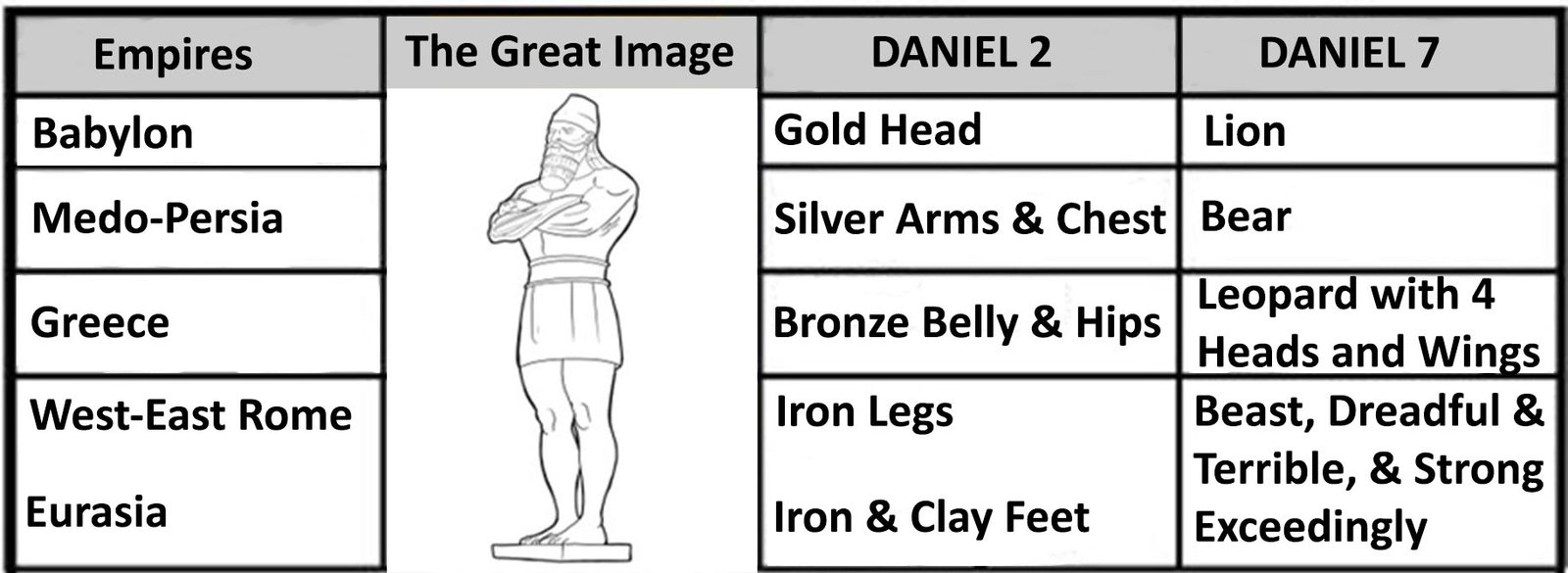
DANIEL 2 SYMBOLISMS
- Metals: Conquest by military
- Clay: Conquest by wealth/industry
- Body Parts: reflect geographical/chronological nature of empires
- Materials: reflect spiritual nature of empires
- Iron/Clay: Militarism mixes with Materialism → powerful religion: Emperor-worship + worship of Materialism
- Legs of iron: West/East territorial division of ancient Rome (European and Asian nations)
- Legs connect to Feet
- Feet continue West/East territorial division of Rome into the west/east division of Eurasia (European and Asian nations)
HOW DANIEL 7 CORRESPONDS TO DANIEL 2
- Beasts of Daniel 7 match with body parts of Image in Daniel 2
- “Fourth kingdom” of Daniel 2 matches with “fourth beast” of Daniel 7
- “Fourth kingdom” contains Legs and Feet – 2 empires – one ancient, one modern
- “Fourth beast” also should contain 2 empires, ancient and modern
WHAT THE ANCIENT AND MODERN VERSIONS OF “4th BEAST” HAVE IN COMMON:
- God reveals Himself through Jesus Christ
- First Coming during ancient Roman times
- Second Coming during the final empire
- Both rule over nation of Israel
- Jerusalem invaded in both eras
- Organized persecution against believers
- Rome’s republican government, law codes still in effect
NOTE: Embellished details show that 4th Beast is more than just ancient Rome. It is also a MODERN empire
DANIEL 7 SYMBOLISMS:
- Beast symbolism reveals inhuman savagery of empires
- Modern version of the “fourth beast“? Russian Federation (in Ezekiel 38-39)
- Who are the “ten horns“? Commonwealth of Independent States forms buffer zone protecting Russia’s long border
- 3 “plucked up by the roots”: Ukraine, Georgia, ?
- “Ten horns” also symbolized in 10 toes of Daniel 2 Image
- Toes connect to the feet, not the legs
- Toes connect to the MODERN version of the “fourth beast”, not the ANCIENT version
WHAT HAPPENS TO THE “4th BEAST”, AND AFTERWARDS?
- Ancient of Days sits, judges “fourth beast”; bestows kingdoms of Earth to Son of Man (7:9-14)
Spirit being explains dream to Daniel (7:15-27)
- Under the “fourth beast”, there will be persecution
- For “time, times, and half a time” (3½ years)
- “Fourth beast” speaks blasphemies against God
- Saints and Son of Man inherit and rule the Earth
FINAL NOTE: Both chapters end with Christ’s Coming to establish God’s Kingdom on Earth. Pictured as a Stone coming to destroy the Image, then becoming “a great mountain” that “filled the whole earth” (2:35) And in chapter 7, “The kingdom and dominion, and the greatness of the kingdoms under the whole heaven, shall be given to the people, the saints of the Most High. His kingdom is an everlasting kingdom, and all dominions shall serve and obey Him.” (7:27)
*
SKELETON OUTLINE OF DANIEL 8
(Based on the series of Posts Daniel 8: Bridging Past and Future)
THE VISION
- Daniel receives a vision, not a dream this time, of a two-horned ram going west, north, and south. It becomes very powerful until a he-goat with a single great horn came from the west and destroyed the ram
- The he-goat’s great horn then gets broken, and in its place four horns spring up. Out of one of those horns, a “little horn” springs up, conquers towards the south, east, and to Israel. He defies the “Prince of the host” and His people and their religious practices.
- That “little horn” identifies with the one in Daniel 7, who was obviously the Antichrist coming in the End of the Age. However, there is a secondary identification with another Antichrist-like person who came to power almost 400 years after Daniel received this revelation. This was Antiochus IV Epiphanes who tried to impose Greek religion on the ancient Israeli nation.
CONVERSATION ABOUT A TIME SPAN OF 2,300 DAYS
- Then Daniel overhears a conversation between two “saints” and learns that this persecution will last 2,300 days. This time span was given to reassure the Jewish people then that their persecution would not last forever. And it so happened, after Antiochus Epiphanes had sacrificed a pig in 167 BC on the Jewish altar (“transgression of desolation” in 8:13), that about 2,300 days later, the Jewish army won a decisive victory over the Syrian forces in the Battle of Adasa in 161 BC. Israel became an independent state after that for about 100 years until the Romans came.
ENTRANCE OF GABRIEL
- At this point when Daniel is wondering what this vision means, the angel Gabriel is sent to explain that the vision is meant for the End of the Age. Daniel apparently had restricted his understanding of the vision to the near-future persecution against Israel with its time span of 2,300 days. This direct encounter with an angel is a bit much for Daniel, and he faints but is re-strengthened and able to continue receiving Gabriel’s words.
GABRIEL EXPLAINS THE VISION
- Gabriel tells Daniel plainly that the ram and the he-goat were symbolic of the upcoming empires of Persia and Greece and that the great horn of the he-goat is the “first king” who can be none other than Alexander the Great.
- Gabriel goes on to describe different features about the “little horn” who, in the vision, causes so much trouble:
1) “In the latter time of their kingdom” – Context is the same Middle East area in a distant future (modern times)
2) “When the transgressors have reached their fullness” – World has reached a stage of complete corruption
3) “A king shall arise, having fierce features” – The final king and his empire will be ruthless
4) “Who understands sinister schemes”- Has great wisdom from the realm of Darkness
5) “His power shall be mighty, but not by his own power” – Great power given to him by the Dark spiritual forces of Satan
6) “He shall destroy fearfully” – Modern means of destruction used against the Harlot empire (with the permission of God, similar to why Assyria, Babylon, Rome were allowed to destroy ancient Israel)
7) “And shall prosper and thrive” – He will succeed in his conquests over the Earth
8) “He shall destroy the mighty, and also the holy people” – He will destroy powerful people and nations, and communities of true believers will suffer much persecution
9) “Through his cunning he shall cause deceit to prosper under his rule” – With the False Prophet’s help, he will wage a war of deceit – propaganda – to persuade the world to follow him
10) “And he shall exalt himself in his heart” – Such arrogance has led to the downfall of many of the world’s great conquerors
11) “He shall destroy many in their prosperity” – Similar to Revelation 18:7-8, many of his enemies’ nations will suffer unexpected destruction
12) “He shall even rise against the Prince of princes” – Ultimate defiance (against God) results in…
13) “He shall be broken without human means” – His defeat, not by an opposing worldly power, but, directly and supernaturally, by the hand of God in the Battle of Armageddon
- At the end of their conversation, Gabriel tells Daniel that the “the vision of the evenings and mornings” (about the 2,300 days) was true. In other words, the vision was multi-layered and, besides its primary application to the End of the Age, could be applied also to the ancient Jewish troubles under Antiochus Epiphanes, who was like a model for us of the final Antichrist.
- After it is all over, Daniel fell sick for a few days. The vision left him somewhat disturbed, and neither he nor anyone else could understand it. And how could they? It was too far into the future. “For it shall be for many days.” (8:26)
[RETURN TO INDEX]
*
(Based on the series of Posts Daniel 9: Second Coming When? Angel Gabriel Explains! )
- Daniel is reviewing Jeremiah’s 70-year prophecy about the time span of Israel’s Captivity in Babylon
- This provides the occasion for Gabriel to return and use Jeremiah’s prophecy to springboard to a new 70-number prophecy, only instead of 70 years, it is 70 “weeks” of years (meaning 70×7 = 490 years)
- The completion of this time span would do more than bring political liberation, but in this case, it was liberation from the captivity of sin and the entrance of God’s people into an era of “everlasting righteousness”
- By the way, the Jewish year (or lunar year) is 360 days, shorter than the solar year we use of 365¼ days. The calculation of the time spans, using lunar years, accords well with the known historical dates of events mentioned in the 70 weeks message
- Gabriel’s prophetic message divides the 70 “weeks” into 4 sections:
1) 7 weeks (49 years): from the time of the Persian king’s authorization to re-build Jerusalem and its wall until the work is completed
2) 62 weeks (434 years): after the 7 weeks (49 years), 434 years pass “until Messiah the Prince”. Jesus makes His appearance, and the 62 weeks probably finishes during His public ministry when He manifests Himself as the Messiah. Since the start of the 490 years, 483 years have now passed, leaving 7 more years to go.
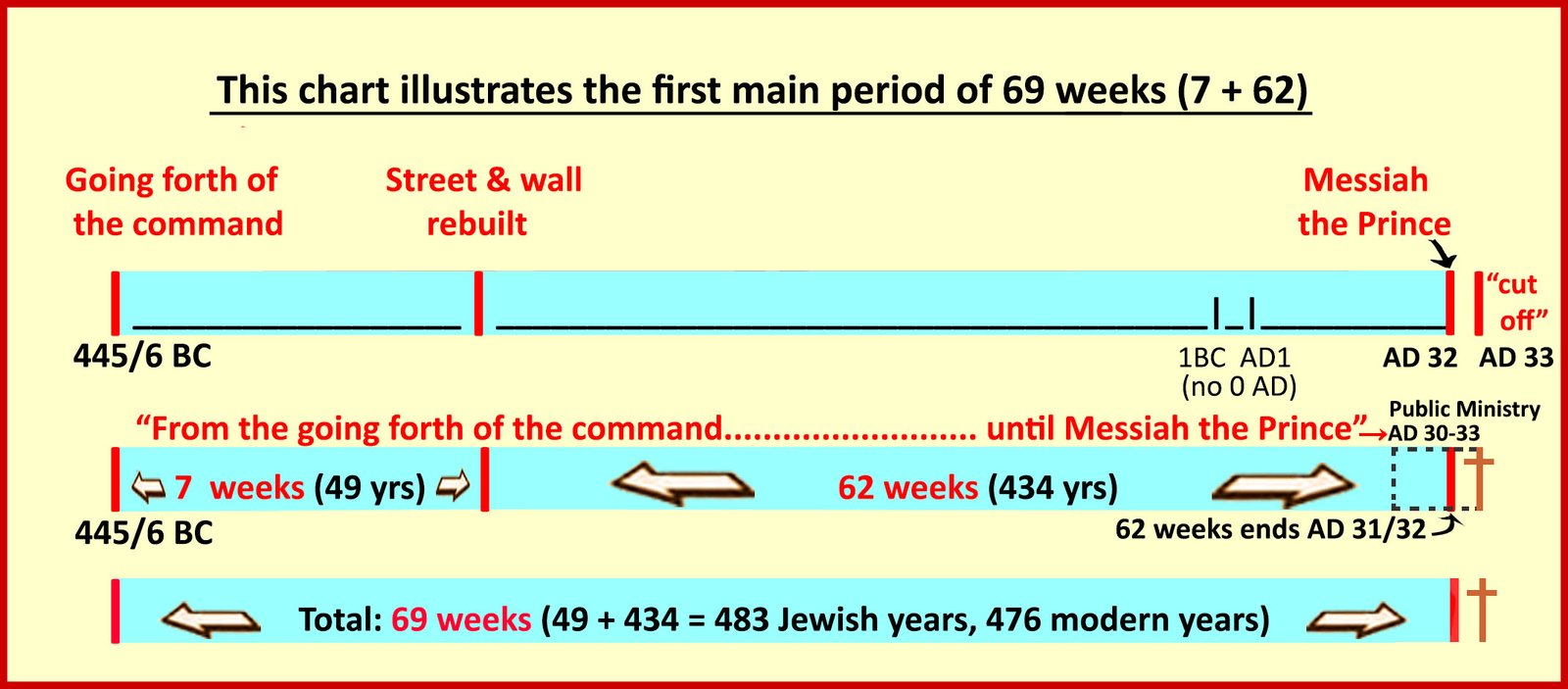
3) A gap of time: Messiah is “cut off” (crucified) AFTER the completion of the 62 weeks. Jerusalem is destroyed and from then on suffers “desolations”. Israel disappears as a nation.
4) 1 week (7 years): As in all of Daniel’s revelations, the prophetic message jumps from an ancient context into a distant future one, the End of the Age. The prophetic message telescopes from the Roman king who destroyed Jerusalem and the temple in ancient times and focuses on his “spiritual descendant” – the Antichrist who comes in modern times to do the same thing.
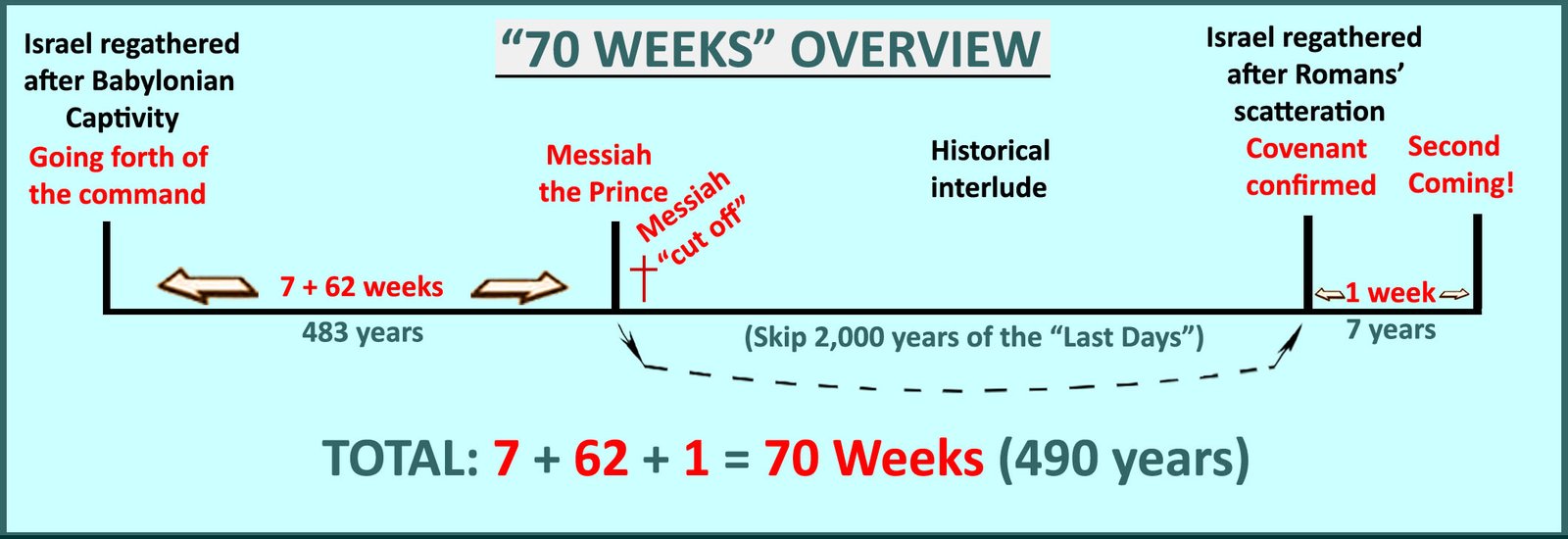
These last 7 years start with the confirming of a covenant by this modern “Antichrist”. The “covenant” appears to be an agreement that allows the Jewish people the religious freedom to continue their worship services in the temple. In the middle of these 7 years, after 3½ years, he invades with an army of “abominations that make desolate”. This sounds like a cryptic reference to modern warfare with its “armies” of drones and vehicles of war. This action results in the halting of religious services. “He shall cause the sacrifice and the oblation to cease.”
From other Scriptures, we can ascertain what happens. One of these desolating abominations enters the temple, and that is what stops religious services. This provocative event signals the start of official worldwide persecution against all true believers. It also signals Christ’s soon return in only 3½ years! The persecution will be for a limited time only. The persecution will be for a limited time, after which God’s judgments on the Antichrist and his followers will be “poured out”. (9:27)
[RETURN TO INDEX]
*
SKELETON OUTLINE OF DANIEL 10 – 12
(Based on the series of Posts Daniel 10-12: Micro/Telescopic View)
DANIEL 10:
- Daniel has spent 3 weeks in fasting and prayer. The Lord appears to him in a form similar to the appearance of Christ in Revelation 1:13-16. This has the same effect on him as it did on John the apostle; he falls into “a deep sleep on my face”. (10:9)
- Then an angel (Gabriel probably) appears to him and says he will reveal to Daniel “what shall befall your people in the latter days”. (10:14) From this we may gather what was the focus of Daniel’s concern: he was praying for his people who at the time were supposed to be re-entering their homeland in Judea, the “Promised Land”.
- The angel informs Daniel that he had to battle with the demon princes of Persia and Greece before he could appear to Daniel. God’s delays are not denials. And we gain some insight into the spiritual realm: nations are ruled by spiritual powers, mostly from the Dark side; and what happens on Earth often reflects what is going on in the Celestial Realm.
DANIEL 11:
- This chapter can be divided into 7 different sections as the angel takes Daniel through different stages of the future history of the Middle East and of Israel.
1) Quick Look at Near-Future History (11:2-4)
- Gabriel’s “telescope” peers quickly through the next 200 years (534-323 BC): Medo-Persia’s history, its collapse before the rising Greek empire, and finally the break-up of Greece into four divisions.
2) Detailed Look at Near-Future History (11:5-20)
- Gabriel’s “telescope” turns into a “microscope” and focuses on the next 150 years (322-175 BC) of wars and turmoil swirling around the land of Judea.
- Of the four divisions of the Greek empire, two of them became major superpowers who were constantly fighting each other for control over Judea: the Ptolemaic dynasty based in Egypt and the Seleucid dynasty based in Syria.
- Israel was ruled by the Ptolemies for about 100 years until the Seleucid dynasty took over in about 200 BC.
- It is an impressive testimony of God’s foresight that enabled the angel to correctly foretell so many future details of Middle East history. Authenticates that what he says about the distant-future will also come to pass.
- The endless series of bloody wars, treacheries, deceptions between the two dynasties exposes how corrupt are the games of power politics that go on in the world. Typical of mankind’s conduct throughout history.
3) Rise of the Antichrist (11:21-22)
- At this point Gabriel’s “telescope” would have focused on the Greek king Antiochus Epiphanes who long ago persecuted the Jewish people in a reign of terror. Verses 21-22 describe the rise to power of this “vile person”: deceptively “by flatteries” followed by crushing all opposition “with the arms of a flood”. This description could apply to both the ancient king and the final Antichrist.
- But the exploits of the ancient king were covered already in chapter 8, so Gabriel’s “telescope” adjusts to a long-distance view of the End-of-the-Age Antichrist, someone who will resemble the ancient king, especially in his obsession with trying to extinguish faith in the true God.
- Mistranslation in verse 22 → much misunderstanding. In ancient Hebrew, the phrase “yea, also the prince of the covenant” is known as a nominal sentence. A better translation would be, “yea, HE IS also the prince of the covenant”. The previous verse 21 introduced a “vile person” who in this verse 22 is identified as the “prince of the covenant”. Gabriel is simply connecting the present revelation to the previous one; the “prince” who “confirms a covenant” (which starts the last 7 years of history) got a brief mention in chapter 9 (verse 27) and re-appears in this new revelation. We are about to learn more about this pivotal End Time figure (who was known also as the “little horn” in chapters 7 and 8).
- From this point on, the passage dwells on events to come. Most commentaries try to interpret the details here in terms of ancient events under Antiochus Epiphanes. However, the events mentioned from here on do not match properly with events in ancient times. The passage is now dealing with distant-future events.
4) First 3½ years of Final 7 Years: Covenant is Made, Major War, Covenant Upsets Antichrist (11:23-30)
- 11:23 – The “covenant” is made, only here it is called a “league”, meaning it is an agreement between warring groups of people, not one between God and humankind
- Several phrases used here were never mentioned regarding the conquests of ancient times (in 11:2-20). Why? because the phrases (in 11:21-35) describe how conquests happen in modern times: 1) “Enter peaceably” 2) “Flatteries” 3) “His fathers… nor his fathers’ fathers” 4) “Forecast his devices against the strongholds”
- “King of the north” (Antichrist) ends up the winner in a war with the “king of the south” (11:25)
- Perhaps these “kings” come from the modern-day nations of Syria and Egypt and are fighting proxy wars on behalf of Russia and America. From Ezekiel 38-39, it is clear that Russia is the “king of the north” or, at the least, the power behind the “king of the north”.
- The war ends with a hastily arranged peace conference (11:27). Are the kings of north and south afraid of starting a nuclear war?
- The “covenant” is still in effect, but the “king of the north” is unhappy with it, despite having gained a great amount of wealth from the war. He gets angry with it when “ships from Cyprus” come against him
5) Last 3½ years of Final 7 Years: Covenant Broken; Abomination of Desolation; Great Tribulation (11:31-35)
- The anti-Christ “king of the north” sends the “abomination that makes desolate” (an armored tank?) into the Jewish “holy place” (Daniel 11:31, 12:11; Matthew 24:15 and Mark 13:14). This violent desecration of a holy place triggers the era of persecution known as the Great Tribulation. Believers around the world, who refuse to renounce their worship of the Most High, suffer persecution from the forces of the Antichrist. It is a time when the power of God is revealed in remarkable ways through miracles of protection, through the teachings and exploits of God’s people in those final days. It is a time also “to refine” and “purify” God’s people. (11:35, 12:10)
6) Description of the Antichrist “King of the North” (11:36-39)
- The anti-Christ “king of the north” has a spiritual life that reflects the secular humanism of modern times. He does not “regard any god” but “shall exalt himself above them all.” “He shall honor a god of fortresses.” His “honor” (rather than “worship”) of a war god of armaments springs from self-admiration of his own great might and strength of arms. With this kind of spiritual life, it is easy to understand why he wants to “pollute the sanctuary” by sending in the destroying abomination. (11:31)
7) Last 3½ Years: Great Tribulation Continues, Antichrist’s Wars Against the World (11:40-45)
- Again, as in the “ships from Cyprus” attack, the “king of the south” tries once more to attack the “king of the north”. Or possibly, it is the same attack. “The king of the north shall come against him like a whirlwind.” (11:40) This sounds ominous and could be the time of the destruction of the Great Harlot empire, described in Revelation 17-18. The Antichrist conquers the entire Middle East area, including Israel and Egypt.
- In the wake of this great victory, the Antichrist is able to establish himself in Jerusalem where, as 2Thessalonians 2:4 teaches, “he sits as God in the temple of God, showing himself that he is God.” But the victory is short-lived, for “he shall come to his end, and no one will help him.” (11:45) From other Scriptures, we learn that the Lord Himself enters the Earthly Realm at this point and destroys the Antichrist and False Prophet and their armies in the Battle of Armageddon.
DANIEL 12
- We learn more about the Great Tribulation (outlined earlier in 11:31-35). Here it is called “a time of trouble such as never was since there was a nation”. We also learn that Michael the archangel is fighting behind the scenes to protect the people of God – and also, according to Revelation 12, to cast Satan and his forces out of the Heavenly Realm.
- The important news here is that God’s people “shall be delivered” – and in the most remarkable way – by being gathered into the Heavenly Realm. This is known as the Rapture or Resurrection. According to Matthew 24:29, it will happen “immediately after [not before] the tribulation of those days”. And it will spare the “elect” from the final Indignation, the Wrath of God upon the Earth.
- There seem to be two classes of resurrected people: 1) Those who are “wise” and “turn many to righteousness” and are rewarded. 2) Those not so wise and are raised to “shame and disgrace”. (12:2-3)
- Details about conditions in the world at this crucial time in history are given: “many shall run to and fro, and knowledge shall increase”. This foretells the great advancements in travel and knowledge that makes the modern world differ so much from the past.
- The revelation is almost finished, and there appear two angelic beings, and another “man clothed in linen”. (12:7) This latter person could well be the same one who appeared at the beginning of this revelation and was also “clothed in linen”. (10:5) This Being makes a solemn declaration of the length of time for the Great Tribulation: “time, times, and an half”. From other Scriptures (Revelation 12:6,14), we know this equals 1,260 days. During this final time period, the Antichrist will “scatter the power of the holy people.”
- Although Daniel is told, “go your way… for the words are closed up and sealed till the time of the end” (12:9), Daniel still wants to know more information about the ending of this “time of trouble”. So he is told of two more time periods of 1,290 days and 1,335 days. Not much information is given about them, and since they take place in the future, it is difficult to know with any great certainty what these time periods are meant to represent. One guess, common among Bible teachers, is that the total length of time (75 days) represents the time span for the final Plagues (known as the Wrath of God), which are described in Revelation 16. Those who are spared through the Resurrection (or Resurrections?), or who manage to live through that final era will be “blessed”. (12:12)
- At last the angel tells Daniel to go and “rest”. (12:13) His job of receiving this remarkable and long revelation is over. And probably, his time on Earth was almost over as well.
[RETURN TO INDEX]
MORE “CAPSULES” COMING!
